

Has Global Fossil Fuel Consumption Already Peaked?
Has Global Fossil Fuel Consumption Already Peaked?
Pielke's Weekly Memo #24

This is an ungated post in my weekly memo series, which are typically for paid subscribers only. Please share and consider a subscription to The Honest Broker, at any level. This community is growing fast and the comments are insightful and respectful. I am learning a lot and I hope you are also. For new readers, you can see a recently updated “reader’s guide” here.
My review of Alex Epstein’s Fossil Future led to a lot of interesting comments and discussion. It also prompted me to dig into some data, and I’ve seen a few things I hadn’t noticed before. Specifically, the world appears to be on the cusp of a major inflection point – peak fossil fuels.
Consider the following three lines of evidence.
First, according BP, since from 2019 to 2021 global fossil fuel consumption remained level, with the exception of the big drop in 2020 due to the pandemic. According to the World Bank, global GDP (in PPP) was 5.7% higher in 2021 than in 2018. You an see the recent plateau in the figure below.
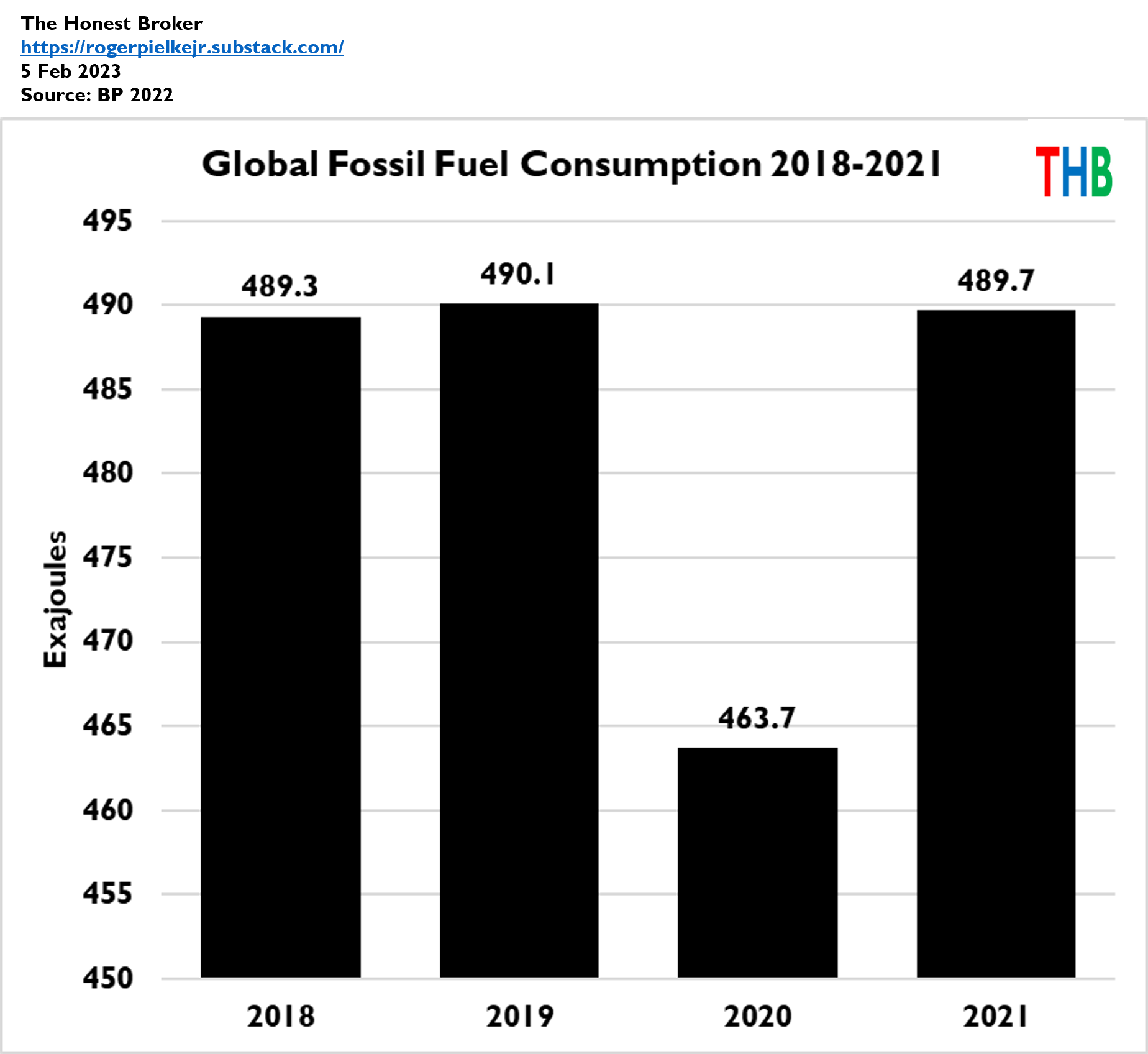
There has only one other period (since 1965) that the world saw a four-year plateau in overall fossil fuel consumption, and that was following the Iranian Revolution of 1979. Total global oil consumption dropped by more than 11% from 1979 to 1983. Oil consumption increased in every year following 1983 until the global financial crisis in 2008-2009.
The 2018-2021 plateau is thus unprecedented. Will 2022 come in above or below 2021 levels of fossil fuel consumption? Take the under.
A second line of evidence can be found in the BP 2023 Energy Outlook, released last week, which projects peak global oil consumption has already happened. Under its New Momentum scenario that is “designed to capture the broad trajectory along which the global energy system is currently travelling,” BP projects a long-term decline in oil and coal. Future policies or technological advancements could accelerate these projections.
The new downward revision in oil and gas consumption in coming years leads BP to project that global carbon dioxide emissions will peak by 2025, and decline rapidly thereafter, even without additional policies.
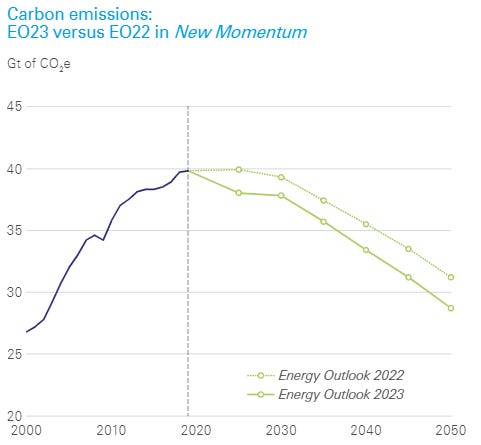
From 2019 to 2050 BP projects in its New Momentum scenario that coal and gas consumption will decrease at rates of 1.6% and 1.0% annually, while natural gas increases at a rate of 0.5% annually, collectively amounting to a steady decline in overall fossil fuel consumption.
A third line of evidence can be seen in the map below. The countries in green are those that reduced their overall fossil fuel consumption from 2000 to 2021 — led by the US, UK, Japan and Germany. In 2021 these 32 countries represented about 50% of global GDP.
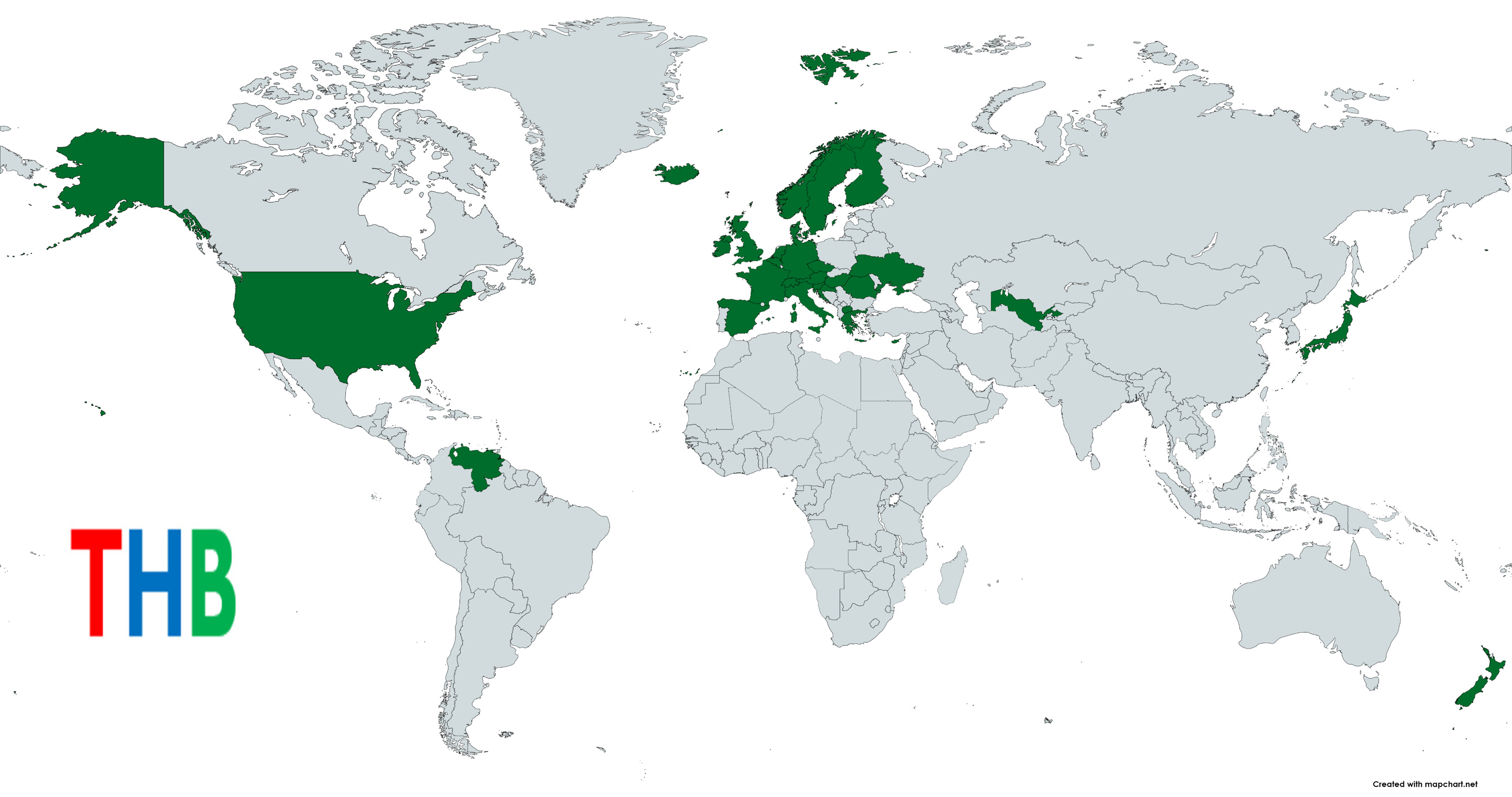
The map shows clearly that future fossil fuel consumption — and whether it grows or falls — will be determined by countries that today are growing their economies and do not yet have the wealth of the countries of the OECD. China and India, in particular are central, but so too (and hopefully sooner rather than later) will be the 50+ countries of the African continent. The long-term plan for reducing fossil fuel consumption is thus — let’s make everyone rich.
But don’t miss the significance of this map — already, countries representing half of the global economy have seen fossil fuel consumption decrease this century. Will the club of countries that reach peak fossil fuels grow or shrink in coming years and decades? Take the over.
Forecasting the future is never easy, and failed forecasts are fun to look back at and have a laugh. At the same time betting against technological innovation is itself a forecast. I don’t know if the world has reached peak fossil fuel consumption, but I’m comfortable claiming that we are getting pretty close, if not there already.
Your thoughts?
Thanks for reading, participating and supporting. Coming soon, Chapter 2 of The Climate Fix for debate and discussion. You can catch up on Chapter 1 here. If you are already a subscriber, please consider gifting a free subscription to that special someone who might enjoy The Honest Broker.
My comment to the previous post on Epstein's book was rather short. It inspired me a more complete version that can be found on my own blog : https://blog.mr-int.ch/?p=9050&lang=en .
This leads me to argue that the metrics that are commonly used are wrong: there is no actionnable content in counting and reporting CO2 emissions or fossil fuel uses. These are fatalistic outcomes from other actions or inactions.
Also, scenarios that project these parameters into a cristal balls are condemned to be wrong (with exception of the only right one but we don't know which is it!).
What counts is the sum of the investments made in the harvesting of non-fossil primary energy, to be expressed in G$ and in TWh/a produced). With some time delay, fossil utilisation and CO2 emissions will correspondingly be reduced.
This is about deliberate human action that will change the framework conditions for energy supply.
As a result, Peak Oil (or Peak Fossils) will be (must be) postponed until these new sources will be sufficient. As investments are far from reaching a pace that would allow for full substitution, more exploration and exploitation of fossils is needed.
Thus, it is better to follow the money that will lead to the desired result rather than to develop a backward-looking accounting that only provokes rather sterile arguments of the blame and shame type.
Studying and monitoring investment scenarios would be more interesting, especially if and when they do not depend on heavy subsidies, i.e. paid for by a political and populist takeover of people's wealth, without any other public economy and social considerations (for example Energy Return on Energy Input, affordable debt burden, adaptation-oriented climate policies, etc.).
"Your thoughts?"
1) Yes, good point.s It is indeed very likely that we're at or near the peak of global carbon dioxide emissions from burning fossil fuels. But this isn't really "news" to someone who two decades ago could look at historical trends in an unbiased manner. As I've noted before, way back in 2006 I predicted that there was a five percent chance that global CO2 emissions (from burning fossil fuels and industrial processes) would peak before 2020, a 50/50 chance they would peak in 2030, and a 5 percent chance they would peak after 2050:
https://markbahner.typepad.com/random_thoughts/2006/04/complete_set_of.html
2) You're right to focus on specific countries and areas of the world, and correct that they are: China, India, and Africa. (No Europe?! Correct, no Europe. Europe has already decided: fossil fuels are goners.) But I would add two additional sub-points:
a) Focus on coal in China and India. And once coal is seen to be near/at/past peak consumption in those countries, focus on oil in those countries. And if oil happens to *already* be past peak in those countries when coal is seen to be near/at/past peak in those countries, then it's game over. Global CO2 emission are headed down without any possible doubt. (Don't bother with natural gas. As the U.S. has shown, if coal is decreasing fast enough, even increasing natural gas consumption doesn't mean an increase in CO2 emissions.)
b) Focus *only* on photovoltaics in Africa. If you don't see photovoltaic contribution to the electricity supply in Africa increasing steadily and significantly, we may already be past the peak of CO2 emissions, but the slope downward will be more gradual. If, as I predict, you *do* see steadily and significantly increasing contributions of photovoltaics to electrical generation in Africa, then the downward slope of global CO2 emissions will be very steep. (Don't worry about coal, oil, or natural gas in Africa. They're meaningless. Coal is meaningless because only South Africa has enough to matter. And that's "matter" to South Africa, not to the continent of Africa's emissions. And oil in Africa will be handled by the global transition to battery electric vehicles.)
Oh, one more thing: It's worth taking a glance at the U.S., in addition to focusing on China, India, and Africa. The U.S. is the global leader in coal reserves, and not just by a little:
https://www.worldometers.info/coal/coal-reserves-by-country/
Yet, coal consumption in the U.S. peaked in 2007, and has declined *substantially* since then:
https://www.statista.com/statistics/184333/coal-energy-consumption-in-the-us/
That alone should have *many years ago* told anyone willing to evaluate trends objectively that the world does not need coal. (Just as battery electric vehicles are now showing the world doesn't need oil either.)