



Just a few days left! The annual subscription for THB increases to $100 on June 1.
Lock in your support at a lower level!
We have just published a new preprint — What demographic prediction can and cannot achieve — that argues that the choice of model drives nearly all the variance in long-run demographic projections, not data quality, not parameter uncertainty. Different modeling frameworks can lead to projected global population for 2075 varying by tens of billions. Fertility assumptions account for roughly 2% of output variance. That means that the numbers we get from any single demographic model tell us more about that model than about the future.
In the preprint, my colleagues Samuele Lo Piano (Gdansk University of Technology), Marta Kuc-Czarnecka (Gdansk), and Andrea Saltelli (Universitat Pompeu Fabra / University of Bergen) and I argue why we should not treat any single demographic trajectory as authoritative. Today’s post summarizes our argument.
Before jumping in, let’s define several key terms:
Demography “is the study of the size, territorial distribution, and composition of population, changes therein, and the components of such changes, which may be identified as natality, mortality, territorial movement (migration),
and social mobility (change of status).”
Demographic models: “refer to all mathematical, statistical, forecast, and microsimulation models that are applied to studies of demographic phenomena.”
Our new paper “investigates the political role of uncertainties in demographic projections by employing a multimodel approach in two case studies.” Let’s take a look.
The Song Jian Lesson
In the late 1970s, Song Jian — a Chinese missile scientist trained in Moscow in control systems theory — traveled to Helsinki for an engineering conference and encountered Dutch mathematicians who had adapted missile guidance equations to population dynamics. Song took the framework back to China, applied it to Chinese demographic data, and produced projections showing China’s population exploding past 4 billion by 2080. Those projections drove the one-child policy, adopted in 1980.
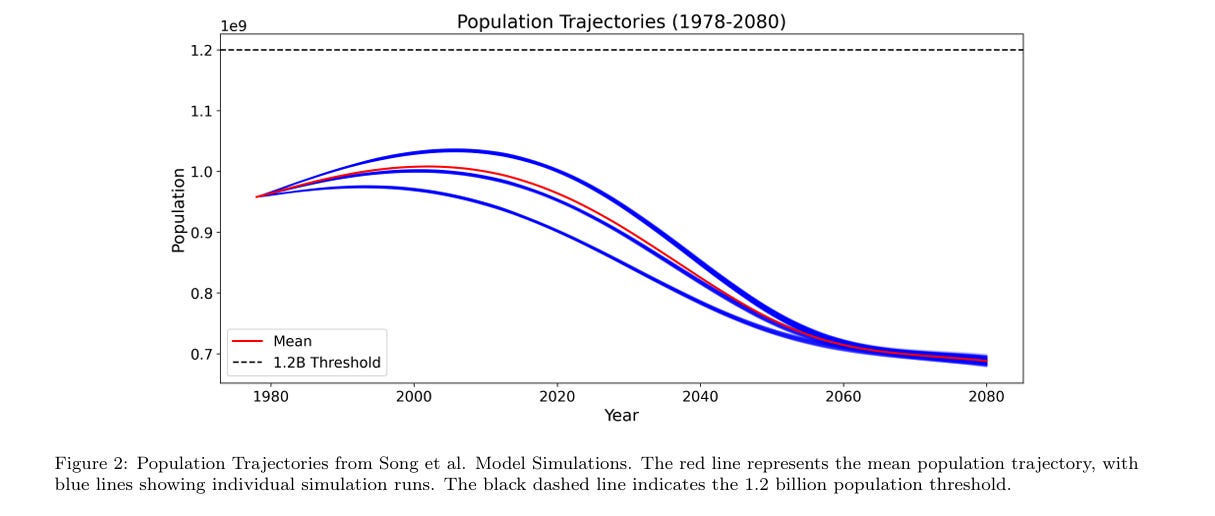
Song’s model targeted an “optimal” population of 700 million by 2080 — framed as a missile guidance problem: what fertility trajectory, applied year by year, steers the population to the desired endpoint?
We reproduced Song’s model and ran 256 simulations, varying eight parameters — initial age structure, mortality trends, sex ratio at birth, and optimization settings — across plausible ranges.
Nearly every simulation converged to 700 million. Even though we changed the inputs, the same answer emerged. The optimization constraints left the model almost no freedom to produce anything different, as shown in the figure below.
Stanford economist Paul Pfleiderer terms this a chameleon model, in the context of economic modeling:
“A model becomes a chameleon when it is built on assumptions with dubious connections to the real world but nevertheless has conclusions that are uncritically (or not critically enough) applied to understanding our economy. As will be discussed below, I call these models chameleons because they change colours in order to avoid having their assumptions subjected to appropriate scrutiny. Chameleons are not just mischievous. They can be harmful—especially when used to inform policy and other decision-making—and they devalue the intellectual currency.”
Think RCP8.5 . . . but I digress.
Song’s model was a chameleon model: The conclusion followed not from the inputs but from the model’s design — the sophisticated methodology provided an illusion of scientific rigor.
A more useful decision-support model responds to its inputs — different assumptions produce different results, and those differences carry information about the significance of different assumptions and real-world opportunities and risks.
In China, the consequences were profound.
China’s demographic decline began much faster than Song’s model projected. The one-child policy partially relaxed in 2016. China’s population peaked and began shrinking in 2022.
Current projections place the end-of-century figure at just over 500 million—nowhere near the “guaranteed” 700 million. The model did not reflect reality.
The Garden of Forking Paths
For global projections to 2050 and 2075, we ran four standard demographic models—the Cohort-Component model, the UN World Population Prospects model, the Lee-Carter model, and the Lotka-Volterra model — using UN baseline data and varying key parameters across 1,024 simulations.
The models produce radically different answers, as you can see in the figure below.
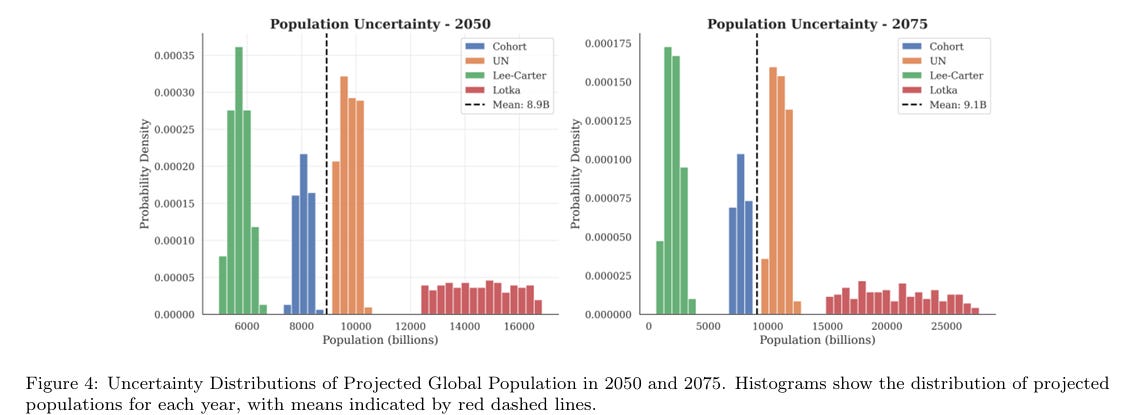
The Cohort-Component and UN models land broadly in the range of perturbed UN forecasts. The Lee-Carter model projects well below 4 billion by 2075 in most runs. The Lotka-Volterra model swings to 15–25 billion by 2075 — likely because improving survival rates cause it to overestimate intrinsic growth, a bias the data compound: cohort fertility has not rebounded anywhere it fell below replacement.
The combined output doesn’t form a bell curve around a central estimate. It forms a multi-peaked distribution, four different narratives with vastly different views of the future.
We performed a sensitivity analysis to decompose the variance: Model choice accounts for 96–98% of projected population variance by 2075. Fertility assumptions contribute roughly 2% and assumptions of mortality and migration are just noise.
This result illustrates the ”garden of forking paths”: at a first decision point in demographic research — which model to use? — the answer may already determine most of the answer.
A while back here at THB, I explored the sensitivity of climate projections to population assumptions. That analysis showed that replacing the population assumptions embedded in SSP2-4.5 (“middle of the road”) with more realistic lower trajectories meaningfully reduces projected 2100 temperatures — because cumulative CO₂ emissions scale with population, and the SSP2 population path sits well above defensible demographic projections. The new CMIP7 HIGH projects >14 billion people in 2100 — also implausible
Our new preprint establishes the methodological foundation for that argument. Demographic projections carry structural uncertainty. The SSP population pathways represent one set of modeling choices among many. And the choice that most consistently inflates projections — model selection — is not considered.
The structural uncertainty in demographic modeling skews toward lower populations than the mainstream SSP assumptions embed.
More precisely, the SSP climate scenarios — the ones the IPCC uses to project future temperatures — each utilize a specific population projection. Our analysis shows that when you run multiple credible demographic models, the results spread across a wide range — and the spread does not center on those SSP population figures. The models that track observed fertility trends most closely, and the simple fact that no country where fertility has fallen below replacement has ever seen it recover, both indicate that the plausible range of population futures is trending downward. That matters for climate projections because, all else equal, more people means more emissions — so inflated population assumptions inflate projected temperatures.
That supports taking the under.
Questions to Ask of Any Projection
A projection states a conditional: if these assumptions hold, this outcome follows. A forecast assigns probabilities. A scenario constructs a plausible narrative without asserting likelihood. Conflating these — such as presenting a conditional projection as a forecast— can lead the false confidence illustrated by the Song Jian episode.
Before using any demographic projection as a policy input, ask three questions:
Does the model respond to its inputs? A model that converges to the same output across varied assumptions reveals a design flaw, and likely not anything empirical about the real world. Sensitivity analysis — systematically varying inputs to observe output change — constitutes basic quality control.
Is structural uncertainty acknowledged? The dominant uncertainty in demographic modeling doesn’t come from the fertility rate or the mortality table. It comes from model choice — and model choice nearly always goes unreported.
Does precision reflect real knowledge? A projection showing 9.7 billion in 2050 doesn’t differ meaningfully from one showing 8.9 billion once you account for structural uncertainty. Spurious precision misleads decision-makers who mistake exactitude for accuracy. Climate model projections conditional on single population projections mask a much larger uncertainty, and that uncertainty is greatest on the cooler side.
Our new paper suggests that individual demographic projections tell us more about the models that generated them than about the future.
The preprint and all data and code are openly available.
Before you go: Please click that “❤️ Like” button. More likes means more readers of THB. Thanks!
Comments welcomed, especially on the preprint itself!
THB exists because of your support. Thanks!
John von Neumann's 1953 quote, "With four parameters I can fit an elephant, and with five I can make him wiggle his trunk." was mentioned when one of the "Climategate" principals was enthusing over the output from an algorithmic black box, unselfconsciously named "MAGIC".
The plunging cost of producing computer generated charting of unwarranted implied precision, to pretend that opaque processing of hundreds of wildly varying "studies" somehow arrives at an authoritative "consensus" about reality, moves us further away from classical "Science" purpose of using curiosity to enable better understanding.
Sid Harris "show your work" cartoon is brilliantly eloquent.
https://cafehayek.com/2014/03/then-a-miracle-occurs.html
Predictions are difficult especially about the future. 🤔