


This is Part 2 in the THB series: Making Sense of the Information Ecosystem. You can find Part 1 here, which introduces some terminology and theory that might make your use of this tool a bit richer. Symbolic politics was a focus of my PhD comprehensive exams back in the day and continues to be a longstanding interest of mine — for instance, see Pielke Jr, R. 2012. Basic research as a political symbol. Minerva 50:339-361.
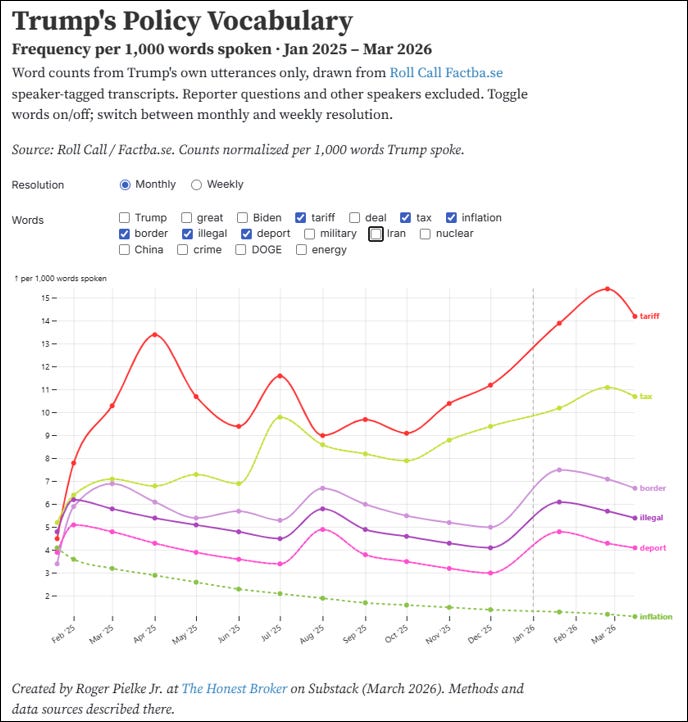
As you know, I’ve been exploring the use of AI in my research. Today I share an interactive chart that I have created that plots the most frequently-used policy-related words uttered by President Donald Trump. The words uttered by any president are important because they shape the national focus of attention, they reflect an administration’s propaganda strategy, and they serve a political function as condensational symbols.
Below is a screenshot of the tool; the interactive version allows you to toggle individual words on and off and switch between monthly and weekly resolution. You can access the interactive version at:
Please go check it out and then come back here and let me know what you think! I plan to update the tool periodically.
Comments welcomed! Please focus on the tool, what it shows, why a focus on presidential focus of attention might (or might not matter), and whatever you find interesting about the time series. Please keep comments focused on the data, the methodology, and what we can together learn from the tool — THB is not the place for partisan cheerleading or booing.
Methodological details: Trump’s Policy Vocabulary tracks the frequency of selected policy-relevant words in Donald Trump's public remarks from his inauguration on January 20, 2025 through March 20, 2026. Words were selected by first identifying the most commonly used policy-relevant terms, then supplementing them with analytically interesting additions. Word counts are drawn from speaker-tagged transcripts available through the Roll Call Factbase database, which provides a near-complete archive of Trump's public statements, including speeches, rallies, press conferences, bill signings, and overseas addresses. Counts reflect only words spoken by Trump himself — reporter questions and remarks by other speakers in the transcripts are excluded. Frequencies are normalized per 1,000 words Trump spoke in a given period, allowing meaningful comparison across months and weeks regardless of how much he spoke. Common stop words are excluded, and root forms are merged (e.g., "deport," "deported," and "deportation" are counted together). The interactive chart was built using Observable Plot, code was produced by Claude AI (Anthropic), all under my direction.
Selected Bibliography - for thoe wanting to dig deeper
Brunner, R.D. (1987). Key political symbols: The dissociation process. Policy Sciences, 20, 53–76.
Edelman, M. (1964). The Symbolic Uses of Politics. University of Illinois Press.
Elder, C.D., & Cobb, R.W. (1983). The Political Uses of Symbols. Longman.
Graber, D.A. (1976). Verbal Behavior and Politics. University of Illinois Press.
Lasswell, H.D., & Kaplan, A. (1950). Power and Society: A Framework for Political Inquiry. Yale University Press.
Before you go — Please click that “❤️ Like”. Thanks!
Announcement: The annual subscription for new subscribers to THB is increasing to $100 on 1 June 2026! Lock in your support at a lower level, at a price that will never increase!
Interesting, but atomizing Trump's words is not very helpful. He speaks like a normal person, not like a scripted politician. You kind of need to hear the whole paragraph to know what he means. Digging down to the word level can be misleading. This is one reason why I always go to the primary source and do not pay any attention to reports about what he supposedly said. It has been a very long time since we had a president who was normal and not a robot.
This is useful. However, the analysis of individual words used by Trump strikes me as less a reflection of the President's policy "vocabulary", and more of a reflection of the most topical issues of the day. Words like "tariff," "border," "inflation," and "China" are common words throughout the media and in the remarks of politicians across the political spectrum because they refer to prominent high-profile issues. To get an idea of how much those words say anything specifically about Trump, we'd have to see how they are used and framed differently from other politicians. Leading Democrats such as Chuck Schumer and Hakeem Jeffries are also talking a lot about these same issues: tariffs, inflation, China, etc. You'd need some kind of multivariate analysis to see what other words those other political figures use in association with tariff, China, etc. For a PCA, for example, the 2nd eigenvector might give you some differentiation.