


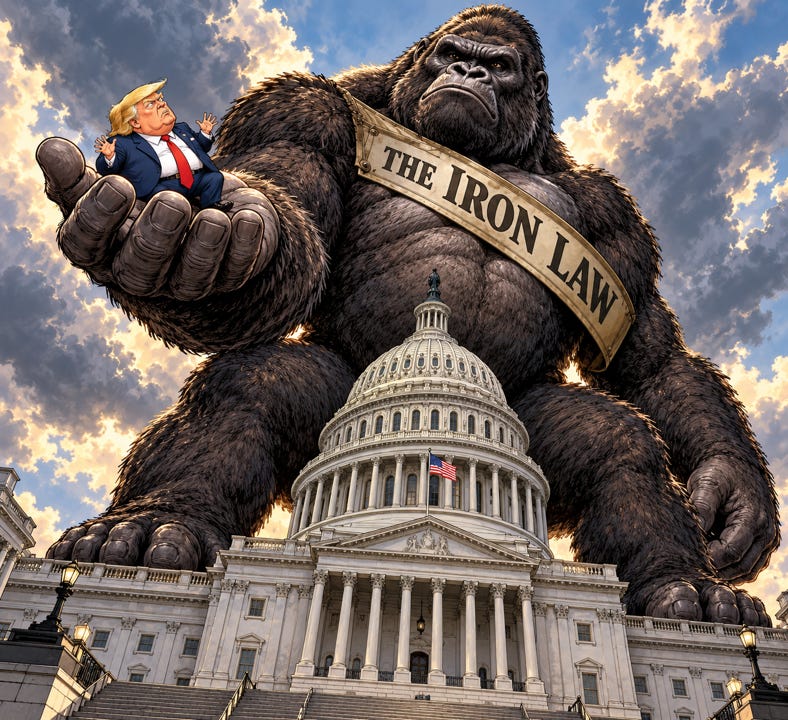
President Donald Trump has done something that decades of climate advocacy and international conferences have never achieved. Global carbon dioxide emissions look set to fall in 2026 by more than in any year since the pandemic — and except for a very small reduction in 2015–16, when Chinese coal use fell, every previous decline followed a recession, a financial crisis, the collapse of the Soviet economy, or a pandemic.1
On 28 February, President Trump went to war with Iran. Traffic through the Strait of Hormuz stopped and oil and gas prices skyrocketed. I was curious about what level of carbon tax would be equivalent to the oil and gas price increases since the military action started and how the public has responded around the world. This post reports what I learned.
The top-line results:
For 2026, global fossil CO₂ emissions are currently expected to fall by about 150 million tonnes (Mt) — or 0.4% — from 2025, the first annual decline since the pandemic in 2020;
The equivalent carbon prices to the fuel price increases — at late September prices — are $298 per tonne of carbon on oil and $848 on European gas;
Consumers have collectively paid about $869 billion in extra payments, equal to an $87 per tonne carbon tax across all fossil fuel emissions;
Combining the reduction in emissions with the costs incurred results in about $21,100 per tonne of carbon avoided;
Global decarbonization — the reduction in the ratio of CO₂ to GDP — accelerates from ~2.9% to ~3.3% per year, versus the 8% to 9% implied by 2050 targets for deep decarbonization;
The public — in the United States and around the world — is dissatisfied with increasing fuels costs and governments are taking action to reduce those costs, before they pay an electoral price;
The experiment is not perfect: the energy price shock raised prices for oil and gas but did not affect coal, the most carbon-intensive fossil fuel — increased coal consumption in 2026 results in an increase of about 190 Mt CO₂ and offset more than half of the emissions reduction due to oil and gas.
A note on units: emissions are expressed as CO₂, and prices appear per tonne of carbon, the convention in the tax literature. A tonne of carbon corresponds to 3.67 tonnes of CO₂.
The natural experiment
A carbon tax raises the price of fossil energy in proportion to its carbon content. The Iran war led to significant supply-driven cost increases in oil and natural gas, beginning 28 February and continuing through September.
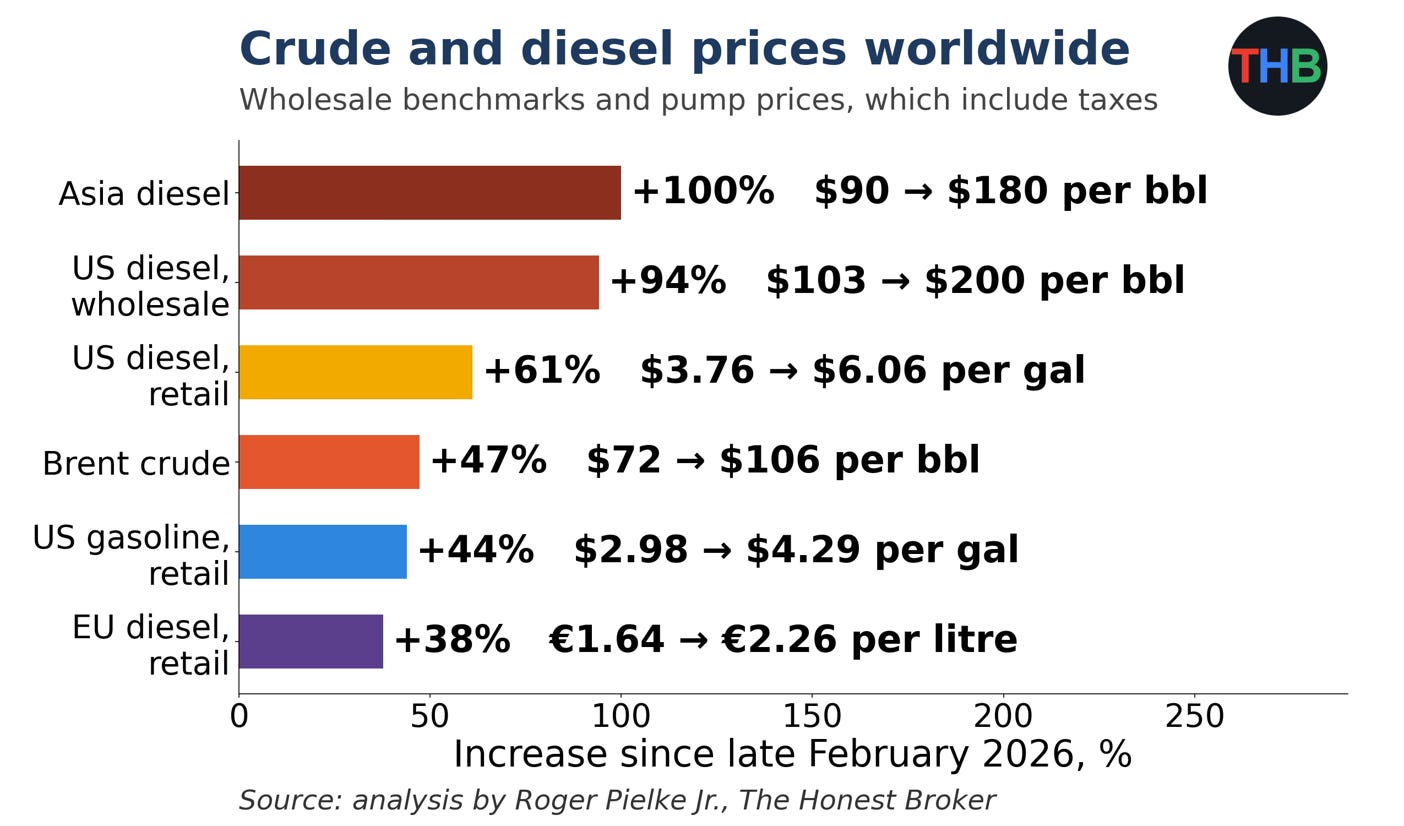
Brent crude traded around $72 per barrel in late February, days before the war, and around $106 in late September, with costs for consumers increasing similarly around the world, as shown in the figure below.
Natural gas prices increased dramatically in Europe and Asia, but not in the United States — as shown in the figure below.
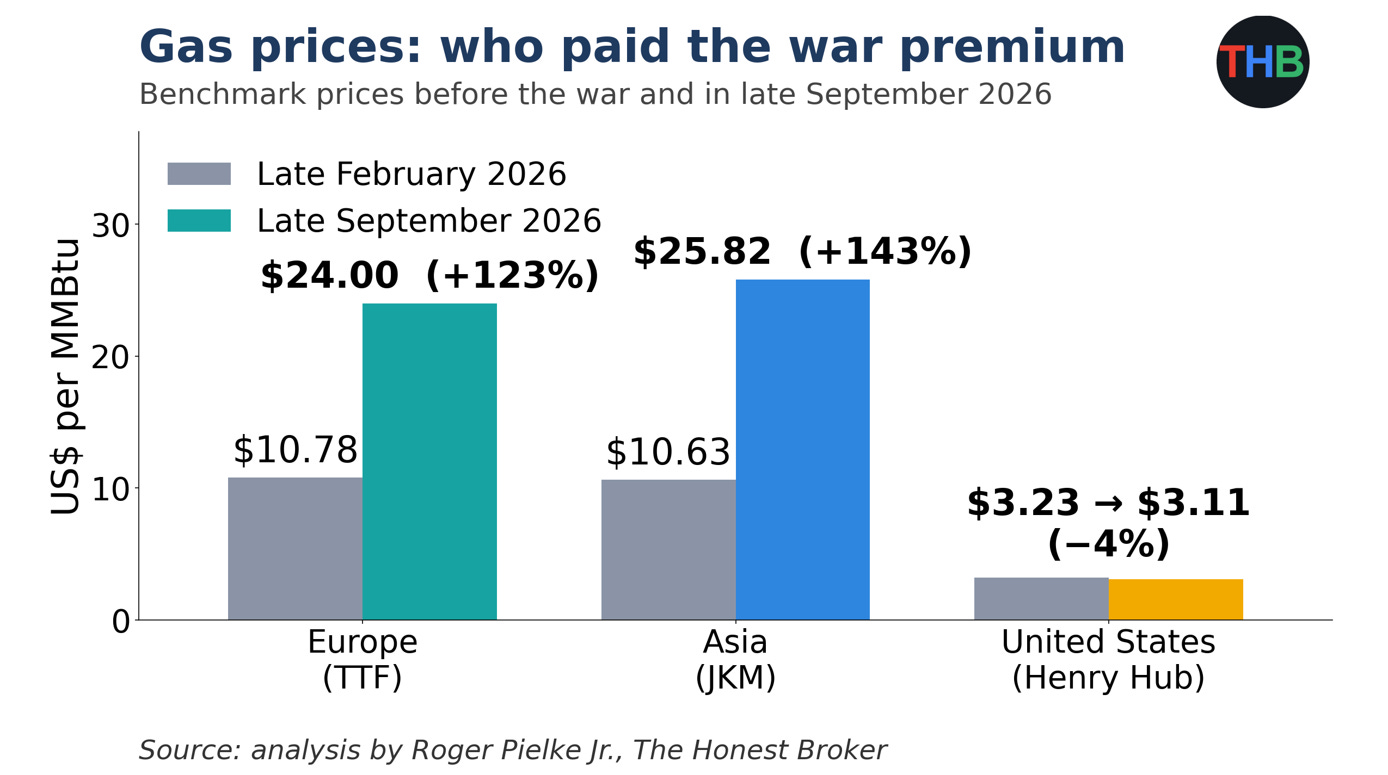
This post assumes a simple counterfactual: Assume prices near the late-February levels and then assess what level of carbon tax would have resulted in the same cost increases. In the detailed technical analysis found at the bottom of this post I perform a sensitivity analysis to varying the assumptions.
What consumers paid per tonne of carbon
A carbon tax of $T raises the price of a barrel of crude by 0.114 x T and a megawatt-hour of gas by 0.055 x T, based on the carbon content of each fuel. These numbers allow us to convert the war price premiums into carbon tax equivalents, shown in the figure below.
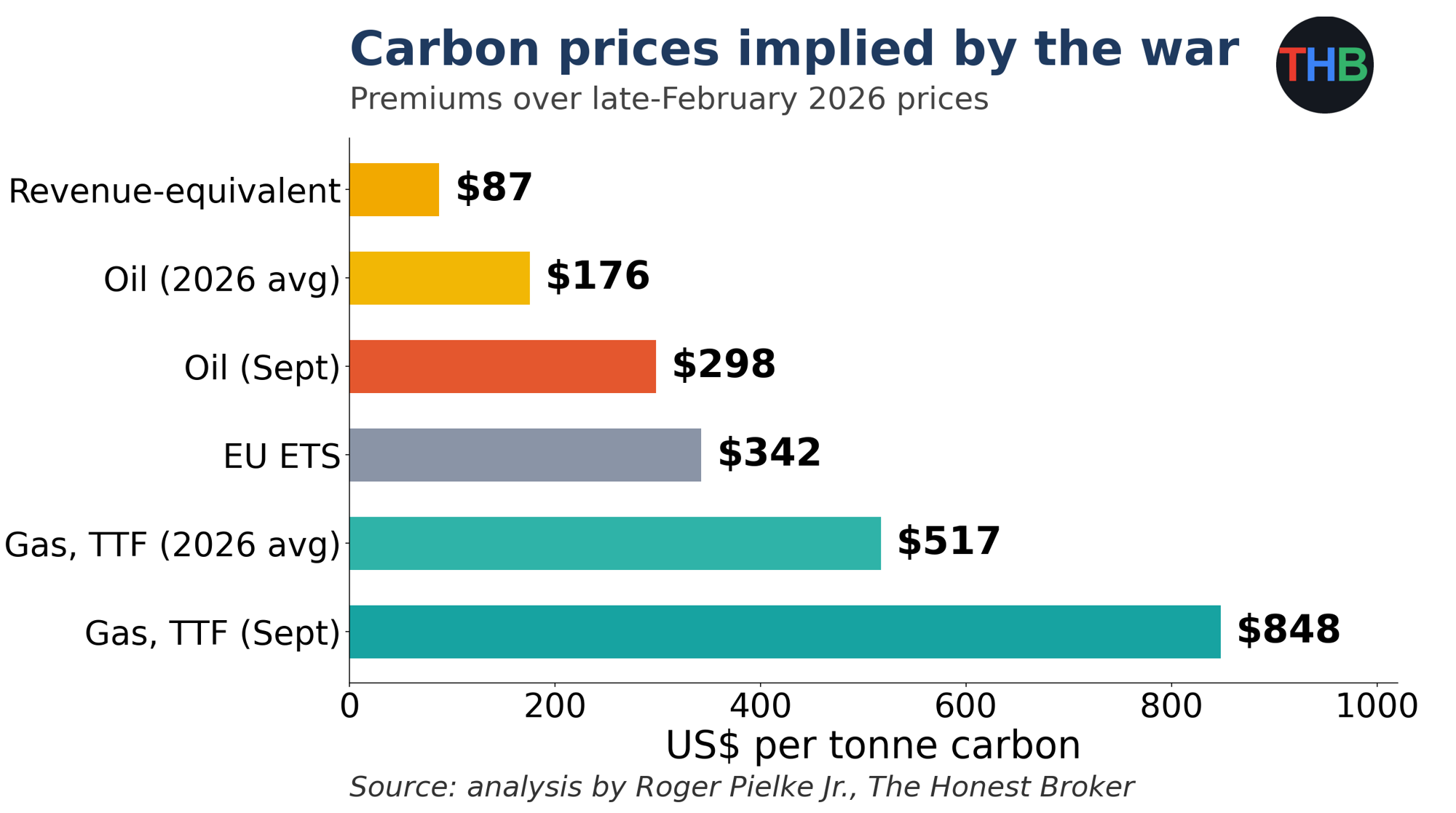
If we attribute the expected drop in global carbon dioxide emissions to the price increases, we can estimate the cost-per-tonne. The $869 billion in war premiums spread across global fossil fuel emissions of 36.5 gigatonnes of CO₂ — or 9.95 gigatonnes of carbon — works out to $87 per tonne of carbon, the rate at which a uniform global carbon tax would raise the $869 billion.
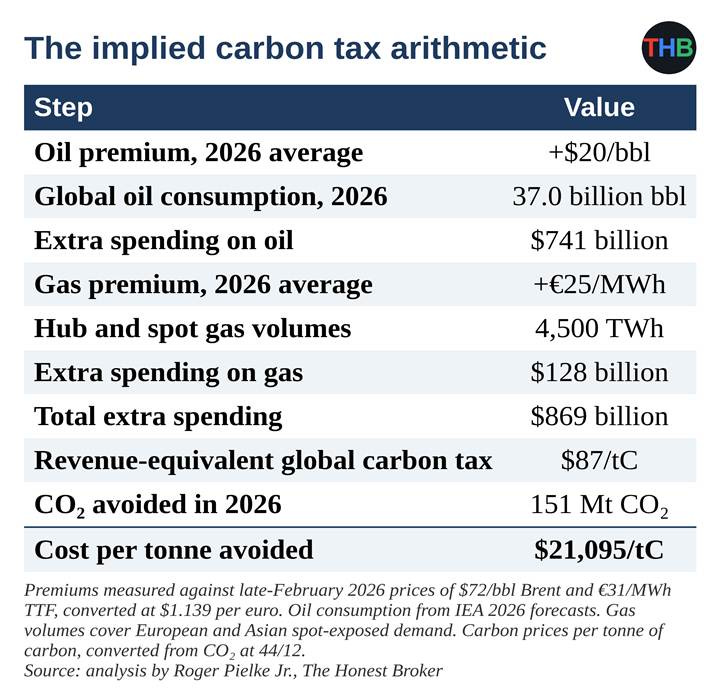
Higher oil prices cost consumers about $741 billion over the year, and higher gas prices about $128 billion more. This works out to a cost-per-tonne of abatement of more than $21,000 per tonne of carbon — not cheap.
The experiment differs from a tax in one very important respect: Governments collect carbon tax revenue and can choose to rebate it to households, cut other taxes, or invest in energy innovation. The war premium goes instead to oil and gas producers, shipowners, and insurers, including Russia and the Gulf exporters still shipping.
The Iron Law rules supreme
Four years ago here at THB, I explained the iron law of climate policy, which I originally conceptualized in The Climate Fix (2010)2:
The iron law of climate policy is immutable. It means that substantially increasing the costs of energy, which supports every aspect of modern life, is off the table as a policy option for achieving deep decarbonization. That goes for formal pricing instruments as well as so-called “shadow” instruments such as efforts to limit supply of energy resources in hopes of driving up prices.
Once we relegate carbon pricing to a secondary role in climate policy, we are able to focus more clearly on the fact that accelerated decarbonization of the economy will occur through developing and deploying technologies of energy production and consumption that are both cleaner and cheaper (in terms of the prices people actually pay today). The iron law means developing policy that goes with the direction of prevailing winds, rather than against them. Its much easier to travel far when we do.
The natural experiment launched by the Trump administration's war with Iran offers a clean test of the iron law — No surprise, it holds.
The figure below left shows overall U.S. public approval on prices and inflation: the higher the prices the lower the approval. The panel on the right shows the correlation of gasoline prices and the Democratic margin on a generic ballot. It turns out that higher energy prices do change the behavior of citizens — they decide to vote against candidates whom they blame for the higher prices.
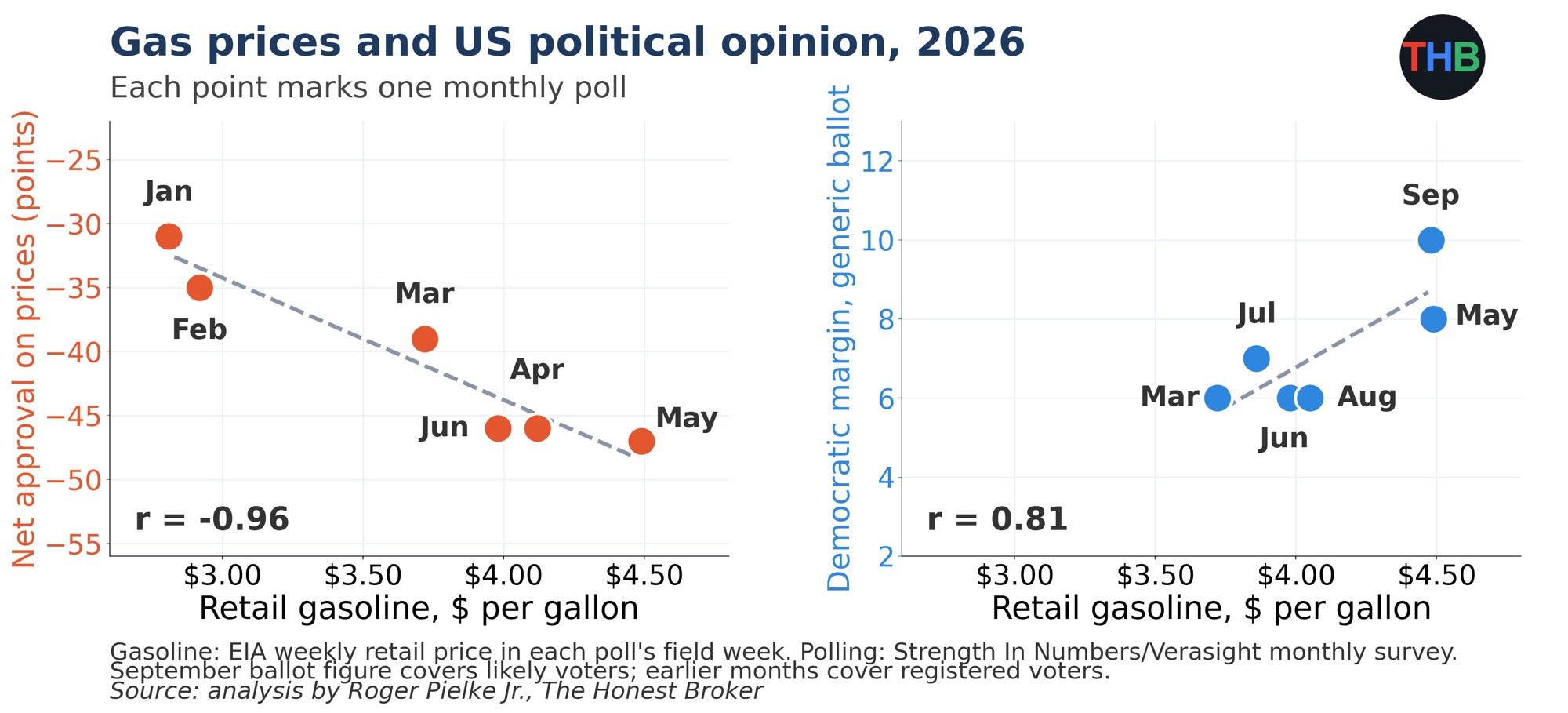
U.S. voters rarely volunteer energy as the nation's top problem: when Gallup asked Americans to list the top three problems facing the nation — without offering a list —very few (<0.5%) said gas prices in every month from September 2025 through February 2026. As fuel prices increased, public dissatisfaction with President Trump also increased: Across the monthly Strength In Numbers/Verasight polls, Trump's net approval on prices fell from
−31 in January,
−35 in February,
−39 in March,
−46 in April,
−47 in May,
-46 in June,
By July, Morris found that 59% of Americans had cut back or delayed other spending because of fuel costs, 51% named Trump and his administration as most responsible for the price of gas, and 47% expected gas prices to carry at least some influence over their vote in November.
It is not just Americans who dislike higher fuel costs. The figure below shows public concern about reliance on foreign energy supply across 31 countries in the context of the Iran war and supply disruption in the Strait of Hormuz, with the change in opinion since February shown for 7 countries (for which data is available).
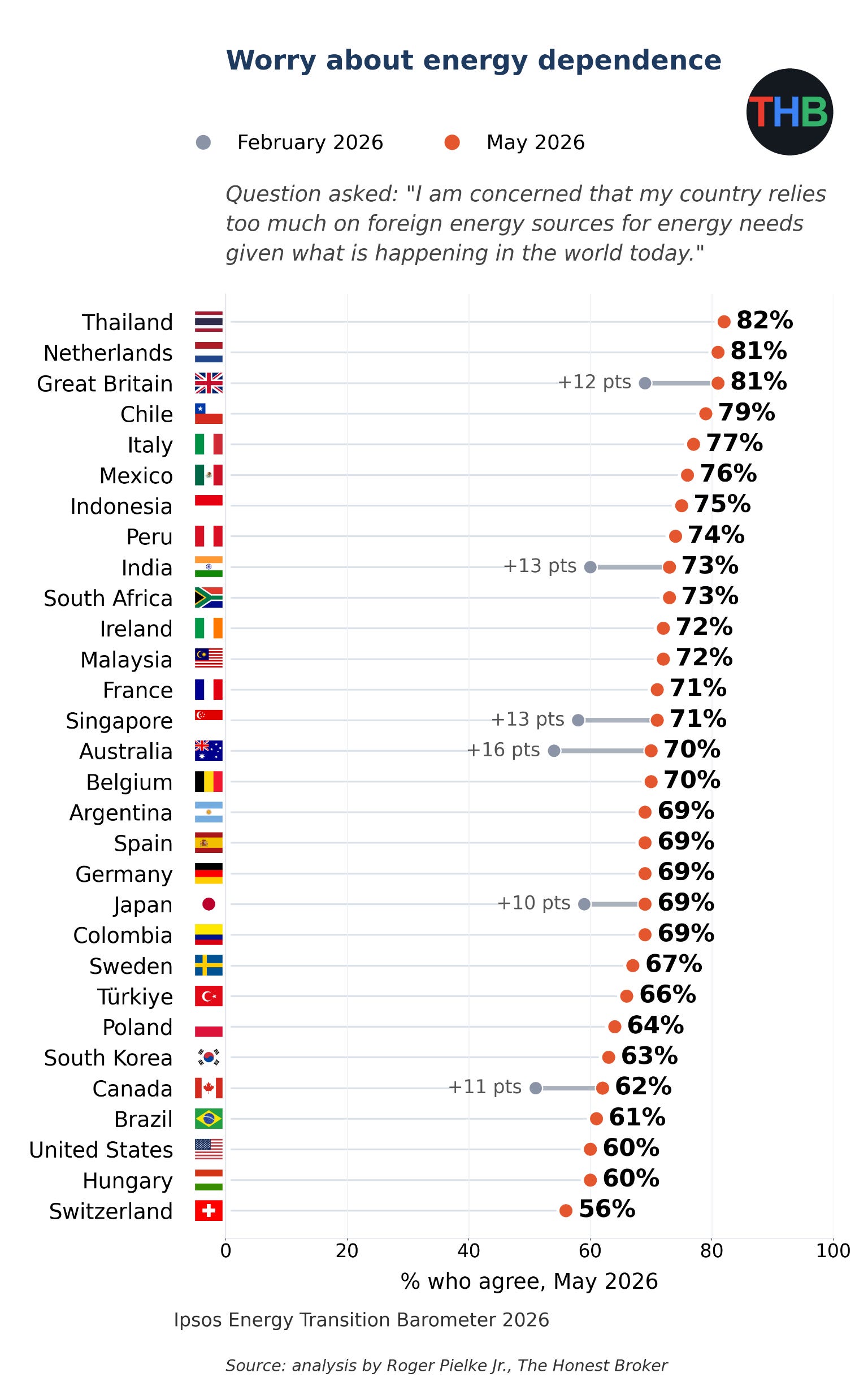
The iron law does not discriminate by country or region. For instance, Ipsos asked Britons between 3 and 7 April what the government should do if the Strait of Hormuz stayed closed. Of those surveyed, 86% reported concern about fuel and energy prices and 80% about fuel availability, and when Ipsos offered a menu of responses, 77% backed a cap on how much fuel companies could raise prices and 68% backed cancelling the planned fuel duty increase, ahead of any measure that would restrict driving or shopping.
A carbon tax would raise prices in order to curb consumption and incentivize substitution. When faced with actual higher energy prices, the British public overwhelmingly wants those prices to come back down. Reaction to a carbon tax would surely be the same.
Bottom line
The Iran war provides an opportunity to assess the impacts of increasing fuel prices on fuel, emissions and public opinion.
For 2026, carbon dioxide emissions from fossil fuels are expected to fall by 0.4%.
Decarbonization accelerated by 0.4 percentage points, far from the 8% to 9% per year implied by 2050 deep decarbonization targets.
Consumers paid an extra $869 billion to producers, which works out to roughly $21,100 for every tonne of carbon avoided.
And in every country where pollsters asked, the public responded to higher energy prices by demanding lower ones: 77% of Britons wanted a cap on fuel prices, 51% of Americans blamed the president for the pump, and his approval on prices fell to −47.
Governments have responded as the iron law predicts, with subsidies, price caps, tax cuts, and more coal. Very high carbon prices would produce economic pain and small emissions reductions at enormous cost. No democratic government would be able to keep such prices in place long enough to find out what effects they might have over a decade.
Deep decarbonization — if it is to occur — will come instead from energy technologies that are cleaner and cheaper than what people use today.
If you think that fuel prices are too high, please click that “❤️ Like” button!
Below, paid subscribers can continue reading, with a much more detailed and technical analysis of the fossil fuel and emissions implications of the price increases in oil and natural gas — with 8 additional figures and tables, a methods appendix, and a 10-tab spreadsheet with all sources and data from this post.
Comments welcomed!
Check out the new THB Data Dashboards and Tools all available at the THB Home Page. New there: Search all past THB posts, a new archive of my Forbes columns, and a new portal for THB Paid Subscribers. And there is lots more to come. Thank you!