



On Friday, the Stern Review on the Economics of Climate Change turns 20. Last night the London School of Economics marked the anniversary with Nicholas Stern and a keynote given by Miatta Fahnbulleh, the current Secretary of State for Energy Security and Net Zero.
Yesterday in The Guardian, Fiona Harvey wrote that Stern’s analysis,
“has been found sound – if anything, he underestimated both the rapidity of heating and economic consequences.”
Actually — as this post shows with evidence — no, neither sound nor underestimated.
The Stern Review dramatically over-predicted economic losses from extreme weather events, and that flawed prediction was based on the misreading of a white paper that I had commissioned for a workshop on extreme weather and climate change.
I explained Stern’s errors in a peer-reviewed paper soon after it was released (an ungated copy of this paper is available at the bottom of this post for paid THB subscribers):
Pielke Jr, R. (2007). Mistreatment of the economic impacts of extreme events in the Stern Review Report on the Economics of Climate Change. Global Environmental Change, 17(3-4), 302-310.
A projection built on a misread white paper
The flawed methodology Stern used to project future losses from extreme weather and climate change begins with a workshop I co-organized with Munich Re in May 2006 at Hohenkammer, Germany. Thirty-two experts unanimously agreed that
“societal change and economic development are the principal factors responsible for the documented increasing losses to date,”
and that it was,
“not possible to determine the portion of the increase in damages that might be attributed to climate change due to GHG emissions.”
Five months later, the Stern Review cited one of the workshop’s white papers, Muir-Wood et al., which I had commissioned, to claim that weather losses had risen 2% per year since the 1970s “over and above changes in wealth, inflation and population” — with the clear implication that climate change was behind the residual increase.
The paper actually found no significant trend for 1950–2005 and 1% for 1970–2005 — a period bookended by low US hurricane incidence in the 1970s and Hurricane Katrina in 2005.
The Review then extrapolated growth in losses as a share of GDP at a rate 2% per year faster than economic growth, and — with even less justification — assumed that losses would increase at an annual rate of 3%, 4%, 5% and 6% in subsequent decades. Those values, it said, were “likely underestimates.” (Details here.)
What actually happened during the next 20 years
Two independent loss datasets allow us to evaluate Stern’s prediction: (a) Munich Re, the source the Review relied on in its projections, and (b) losses provided by Aon. I start each projection from the data available before the Review (Munich Re 1990–2005; Aon 2000–2005) and exclude earthquakes.
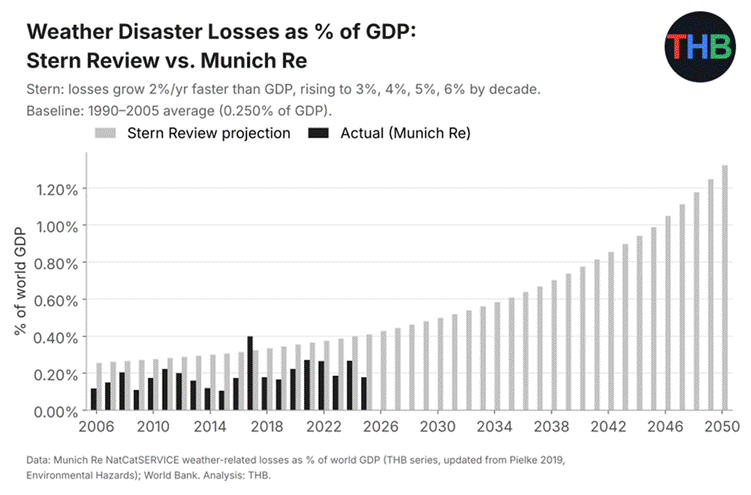
With Munich Re data, losses exceeded Stern’s projection in one year of twenty (2017). In 2025 they were 0.18% of GDP, versus a projected 0.41%. Since 1990 there has been no upward trend at all in total losses from weather extremes as a proportion of GDP.
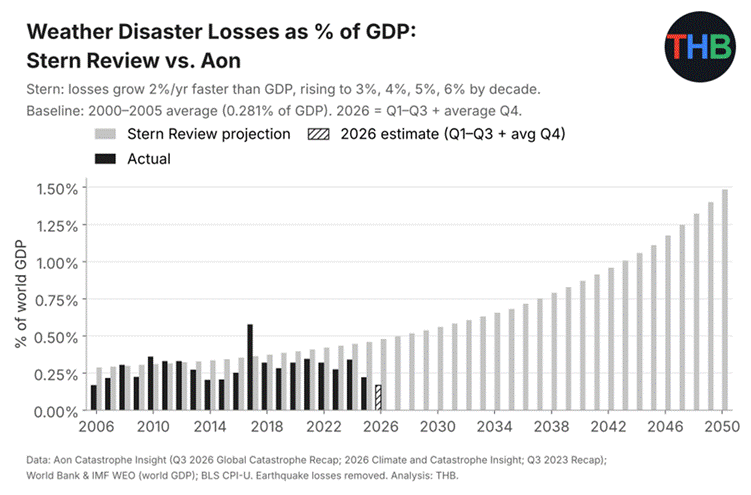
Using Aon data, the story is the same: 0.22% of GDP in 2025 versus 0.46% projected, and below the projection every year since 2017. Through September 2026, losses are running at about one-third of Stern’s projection.
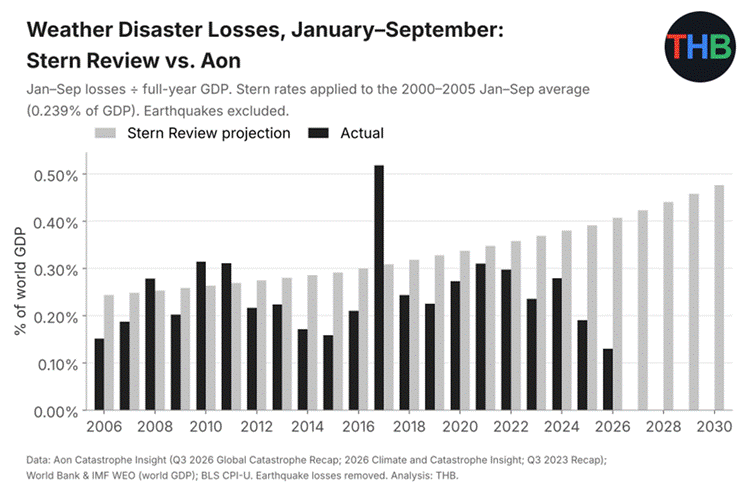
Aon’s estimates of total losses routinely run much higher than Munich Re’s (about 50% higher over 2006–2025, and higher in 25 of the last 26 years) because total losses are estimates made with proprietary, undisclosed methods.
Insured losses are different. They reflect claims that companies are legally required to report accurately, so the two firms’ insured figures sit much closer together (more here).
Insured losses have increased faster than total losses, mainly because more losses are insured: about 25% of weather losses in the early 2000s were covered by insurance, rising to about 40% today.
The bottom line, in 2026 dollars
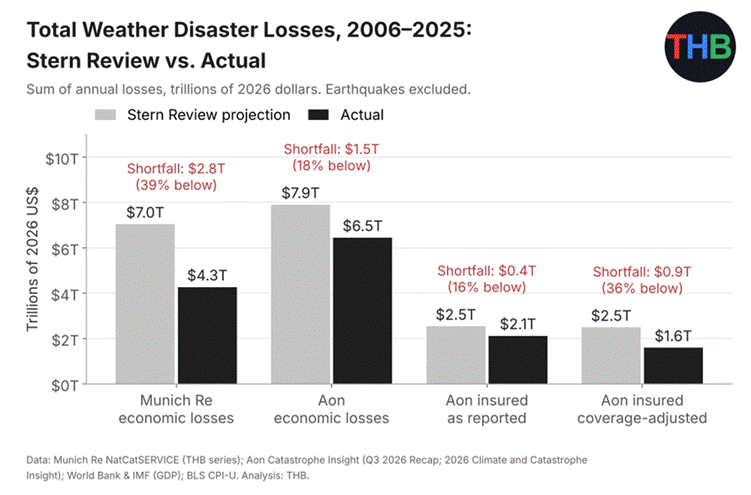
Over 2006 to 2025, the Stern Review’s projection implied $7.0 trillion in weather losses based on Munich Re’s data, in 2026 dollars. Actual losses were $4.3 trillion, $2.8 trillion less. Using Aon’s data, the shortfall is $1.5 trillion.
The gap between reality and Stern Review predictions for losses from extreme weather is likely to get larger and larger in future years and decades.
Why it matters
The Review helped make rapidly escalating disaster costs a pillar of climate advocacy and, later, of “climate risk” in finance. Six years later the IPCC offered an opportunity for course correction with its Special Report on Extreme Events. Instead, climate advocates hitched their wagon to apocalyptic visions of ever-worsening disasters. Reality tells a much different story.
Before you go, please click the “❤️ Like” button!
Want to see what official data says about trends in extreme weather?
You are in luck: Check out the THB dashboards:
US Extreme Weather and Climate Change
Global Extreme Weather and Climate Change Dashboard
Please explore and share — Thank you!
Comments welcome!
THB is made possible by its subscribers. Please consider a free or paid subscription — Thanks!
Further reading:

THB paid subscribers can access a spreadsheet with all data used in the figures above as well as a PDF of Pielke (2007) on the Stern Review.