
The Environmental Trinity
A guest post by Jesse H. Ausubel, Director, Program for the Human Environment at The Rockefeller University


Today, I am happy to share a brilliant talk given last week at The Breakthrough Dialogue by Jesse Ausubel, of The Rockefeller University. I was first introduced to Jesse almost 30 years ago by my post-doc mentor and our mutual friend Mickey Glantz. Jesse’s work has been pathbreaking for decades — when it comes to energy and climate, Jesse has long been out in front. For those wanting to hear more, check out Jesse being interviewed by Robert Bryce. Enjoy this post, I sure did! — RP
The Environmental Trinity — 20 June 20241
A century ago Gertrude Stein remarked profoundly that America was the oldest country in the world because it had been in the 20th century longer than any other country.2 The Breakthrough Institute may now be the oldest environmental NGO because of its prescient founding Manifesto and subsequent 2015 Ecomodernist Manifesto.
This morning I would like to offer my own definition of environmentalism and explore briefly the vital signs in its trinity of components. My environmental trinity consists of Decarbonization, Dematerialization, and Land-sparing, the dynamic core of Ecomodernism.
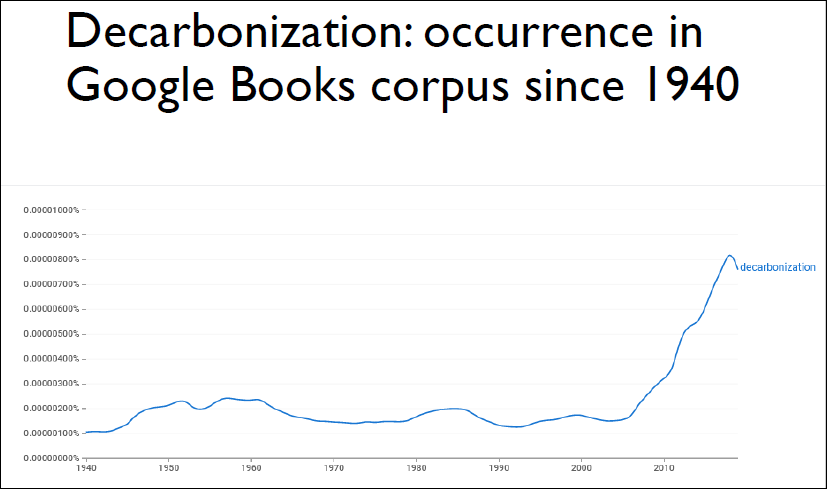
Let me begin with Decarbonization. A Google Books Ngram charts occurrences of the word Decarbonization since 1940 (Figure 1). Most occurrences before about 2005 referred to levels of bubbles in soda pop and other chemical processes. The energy roots date back to the early 1980s when my late mentor Cesare Marchetti first plotted the evolution of the ratio of hydrogen to carbon atoms in the global primary energy mix from 1860 to 1970.3 Marchetti saw evolution as a series of replacements. He put all the hydrocarbons - wood, hay, coal, oil, and gas - that humans used each decade in an imaginary blender and charted the resulting substitution of Hs for Cs. During the 1980s, Nebojsa Nakicenovic and Arnulf Gruebler at IIASA in Austria, Japanese analysts Yoichi Kaya and Kenji Yamaji, and I began carefully measuring changing carbon intensities and using the term “decarbonization.” In about 2005 decarbonization entered the popular lexicon and its frequency multiplied 8-fold by 2019.
Consider Marchetti’s placental figure (Figure 2). The time series of the ratio of Hs to Cs formed a straight line on semi-log paper, equivalent to a long S-curve in which hydrogen gradually takes share from carbon in the energy market. At a finer level, the monotonic line represented the successive dominance of wood (and hay), coal, and oil, and gave us great confidence to predict that hydrogen-rich CH4 would govern the fuel mix of the next 50 years or more in an era when many believed in the geological scarcity of natural gas, before discovery of deep offshore gas deposits or fracking.

Energy was on a marvelous trajectory, one might say in continuous transition, driven apparently by spatial density of energy consumption at the level of the end user. Marchetti envisioned the global journey from hay to hydrogen, from 10% H to 90% H, would take 320 years, from a shortly before 1800 to shortly after 2100. But what has happened?
It is somehow amusing that the outcome of all the huffing and puffing by politicians, diplomats, professors, investors, and protestors was perfect maintenance of the status quo. Energy was in transition until we began ogling it. Policy seems to act like fentanyl for the energy system.
Using the more detailed historical data on fuels now available and bringing the time series up to 2021 for the world and 2023 for the USA, we find disappointingly that, beginning about 1970, America and the world stopped the energy transition measured by our progressive indicator (Figure 3).
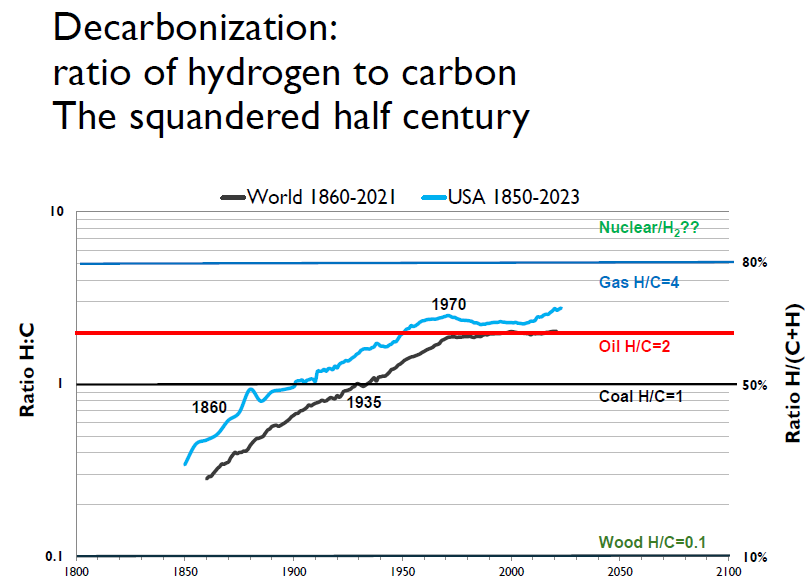
Concurrent with the growth of energy policy, ministries of energy, and academic centers for study of energy, humanity seems to have narcotized the energy system. A substitution process that had proceeded happily and unnoticed for about 200 years came to a halt, in fact slightly reversed in the USA and flatlined globally for about 50 years.
For provocation, I will offer the hypothesis of what sociologists call Reflexivity. Some flavors of reflexivity, making the system conscious of itself, lead to hardening of interests and stasis. Sociologists speak of reflexivity as a feature of modernity, and it certainly seems part of eco-modernity. Anyway, it is somehow amusing that the outcome of all the huffing and puffing by politicians, diplomats, professors, investors, and protestors was perfect maintenance of the status quo. Energy was in transition until we began ogling it. Policy seems to act like fentanyl for the energy system.
Where is our energy Narcan? How do we get beyond the difficulty of being both the subject and the object, and act? The needed actions have not changed in 50 years. We need to move up the line by substituting Hs for Cs, favoring natural gas over coal and oil. We need worldwide diffusion of large near-zero emission power plants, like those of the USA company Net Power, which promises operating facilities in Texas in 2027.
And, to go beyond 80% H molecules, we need to build large nuclear power parks that make hydrogen as a flexible intermediate which stores nuclear heat as chemical energy. The abundant hydrogen can in turn reduce ores, heat homes and industries, synthesize chemicals, produce liquid fuels such as methanol and ammonia, run engines, and even provide feedstock for producing foods.
It’s important to grasp that hydrogen is finally above all a way to store nuclear energy. Full stop. Abundant nuclear causes, indeed requires, abundant hydrogen.
Happily, the drowsy USA energy system seems to stir with the switching on of the two new Vogtle nuclear plants in Georgia. Tom Fanning, recently retired CEO of Southern Company to whom we are most indebted for the plants, was the rare CEO who did not succumb in the land of the Lotus Eaters. On 31 May in Georgia, the US Secretary of Energy rightly said, “Okay, two down, 198 to go,” by 2050. Let’s make a growing fraction of the 198 reactors high-temperature machines that can thermochemically make the hydrogen that sustain the USA on the track of Decarbonization on beyond methane.
If the monstrous contribution of dying old Environmentalism over the past 50 years was to refuse Decarbonization while accepting its rhetoric, what about Decarbonization’s twin, Dematerialization? (Figure 4) Another Italian physicist, Umberto Colombo, fathered modern usage of Dematerialization.4 Chair or director general of some of Italy’s largest energy companies as well as an early member of the Club of Rome, Colombo was keenly interested in volumes of stuff, especially metals, and generation of waste, and around 1980 began to pose the question of whether an overall societal Dematerialization was possible.
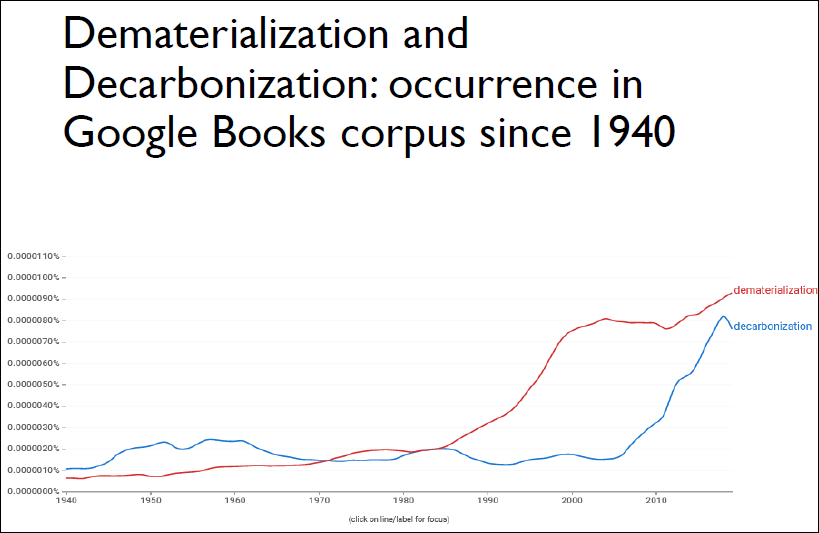
Iddo [Wernick] and I with another physicist, American Robert Herman, who shared in the discovery of the cosmic microwave background radiation that confirmed the Big Bang, had endless fun during the 1980s and 1990s exploring whether, for example, a typical car or building had become lighter and whether various technical and behavioral changes favored lessened use of materials. People giggled when we first talked about Dematerialization, but like Decarbonization, it came into vogue.
Let me begin with a loud, contemporary example of Dematerialization, made in California, indeed in Berkeley by the company Meyer Sound (Figure 5). Contrast a Grateful Dead 1985 concert with a 2024 Metallica concert, where one-third the loudspeakers cover an entire stadium five times larger than Berkeley’s Greek theater. The Metallica system has 90% more energy efficient amplifiers built into the smaller boxes. Signals are sent from the mixing console to the loudspeakers over a slender fiber optic network instead of through heavy cables. The Metallica stage is also dematerialized, completely free of guitar and bass amplifiers; the guitar sounds travel wirelessly to receivers under the stage.

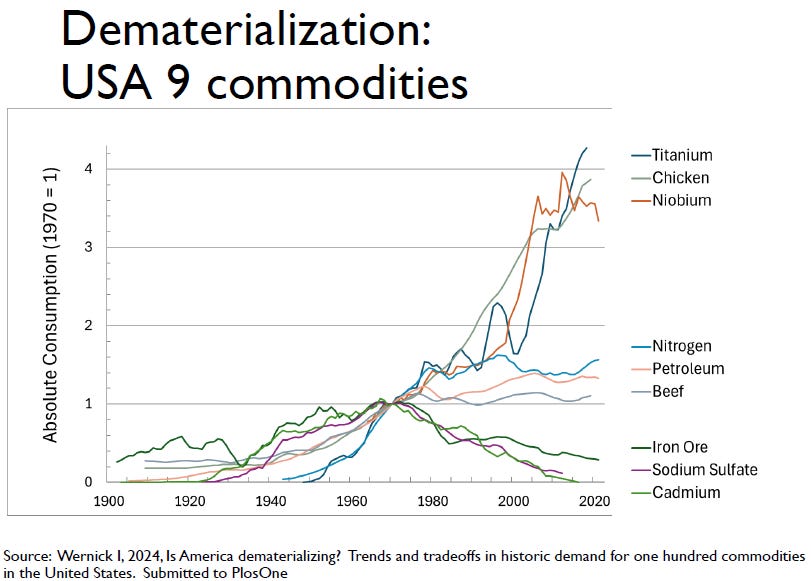
To our surprise, in a study of use of 100 commodities in the USA from 1900 to 2020 Iddo and I found Dematerialization occurring extensively, both in absolute terms (of weight or volume) and in relative terms where the weight or volume is compared to gross domestic product. First consider trends in absolute consumption for nine representative commodities (Figure 6). Cadmium, sodium sulfate, and iron grew to 1970 but then absolutely dematerialized. Interestingly, we found that 1970, year of the first Earth Day, was the American year of Peak Materialization, when use of many of the 100 commodities either began to fall or plateau. Iron ore, beef, and petroleum plateaued since 1970. Meanwhile, niobium, chicken, and titanium have dramatically materialized, with amounts roughly quadrupling.
The list of the 100 commodities we considered spans an overwhelming fraction of the stuff of the USA or any economy (Figure 7). The 41 items in blue, from asbestos to water to cropland, have dematerialized in both absolute and relative terms. The 51 in green from sulfur to silver to sand & gravel, are dematerializing by one measure and materializing by another. Only the 9 in red, from chickens to gallium and rhenium, are materializing in both absolute and relative terms.

One can align all 100 commodities on a chart that has absolute use on one axis and relative use (or intensity) on another (Figure 8). The outcome offers a material definition of Ecomodernism, which I like to summarize as “chickens and gallium.” The quartet of population, affluence, consumer taste (or behavior), and technical change all impact Materialization,5 as does trade, but it’s clear the USA economy is in a very different phase than before 1970, the time of America’s ecological Big Bang. Since then, I would summarize by saying more bits and bytes and fewer liters and kilos, though still a lot. Newly popular materials like Gallium one can think of as vitamins – or information – that allow the bulky elements to stay lean.

Now let us shift attention in the odd couple of Gallium and Chickens to the poultry. Already having great fun with Decarbonization and Dematerialization,6 about 1990 agronomist Paul Waggoner and I asked the question “How Much Land Can Ten Billion People Spare for Nature?”7 Conventional wisdom held that all the planet’s arable land would be used, remaining forests would be shaved, that the prospects for land-sparing or a great restoration of Nature were essentially nil. The prospect was so unlikely that no one needed to use the phrase land-sparing (Figure 9).

Yet, a great reversal of land use was already underway. Let’s set aside discussions about exactly how to measure land use and land cover and their changes, which abound in both agriculture and forestry. The big picture, recently well-summarized by Hannah Ritchie in her book8 and the site Our World In Data, is firm. About 1960 a great reversal in land-use in the USA occurred as land in farms began to peak (Figure 10).

A cluster of technologies spanning ways to plant, seeds, weather forecasts, and sensors of many kinds, which we bundle under the rubric Precision Agriculture, allowed outputs of crops to grow while land and most other inputs (except information) stayed level or even shrank. USA farmers again achieved record average corn yields in 2023, about 12 tons per hectare, 50% more than a generation ago. The winner of the National Corn Growers Contest, David Hula of Charles City VA, grew an astounding record of 42 tons per hectare, while the top grower in the competition with strict nitrogen fertilizer limits grew about 21. (A Hula hectare produces enough calories to feed more than 130 people for a year, while an American hectare in 1900 produced enough for only four people.) The global land-sparing pattern seems to follow the USA pattern by about 30 years.
In conclusion, where have America and the world come since the Death of Environmentalism?
On Decarbonization, not far. America and the world wasted several decades, but perhaps finally America is resuming the light path of natural gas and nuclear and hydrogen. America has passed peak CO2 emissions, and globally Peak C may be in sight.
On Dematerialization, some surprising successes, at least in America. “Peak stuff” may not be as crazy an idea as it seemed, though the total infrastructure to satisfy the virtual, immersive, and autonomous desires of humanity will be very large. Large parts of the world will materialize for decades to come, though more efficiently than the early materializers.9
On Land-Sparing, Peak Farmland is past or now. While regional tragedies of land use and deforestation persist, the global prospect for land-sparing is bright. Let’s hope that sea-sparing follows, but so far we observe mainly continuing industrialization of the oceans.
We could speak of Peak Baby, which also seems to have occurred (2007 in USA and 2012 globally), but perhaps more striking is the extraordinary penetration of the trio of memes, Decarbonization, Dematerialization, and Land-Sparing, that I have discussed and that Breakthrough has advanced in many ways. We need all three for environmental salvation. Regrettably, wind, solar, and biomass fail badly on Dematerialization and Land-Sparing. If we agree with Plato that things begin first in the mind, then perhaps the Death of Environmentalism will be followed now by large collective movements, often quiet, to implement Ecomodernism, that, is decoupling from carbon, materials, and land.
In closing, I recur to a variation on Gertrude Stein’s question, “What is the oldest country in the world?” Let us try to learn by asking “Who has been longest in the 21st century?” Shanghai? Florida? The LNG-powered cruise ship Icon of the Seas carrying almost 10,000 passengers and crew? Perhaps for the next two days the answer is Sausalito. Thank you.
Thanks for reading! THB is a group effort and exists because of your support. Comments, critique, and discussion are all welcome.
Thanks to Ted Nordhaus, Alex Trembath, and The Breakthrough Institute team for the honor to participate in the Breakthrough Dialogue 2024 and to open today’s session as we revisit, after 20 years, “The Death of Environmentalism.” Thanks to Iddo Wernick, my long-time partner in studies I will report.
Stein, G. (1933). Autobiography of Alice B. Toklas. Chap. 4.
Marchetti, C. (1985). Nuclear plants and nuclear niches: on the generation of nuclear energy during the last twenty years. Nuclear Science and Engineering, 90(4), 521-526.
Gabor, D., Colombo, U. (1978). Beyond the Age of Waste: A Report to the Club of Rome. Pergamon.
Waggoner, P. E., & Ausubel, J. H. (2002). A framework for sustainability science: a renovated IPAT identity. Proceedings of the National Academy of Sciences, 99(12), 7860-7865.
Ausubel, J. H. (1992). Energy and environment: the light path. Energy Systems and Policy, 15, 181-181.
Waggoner, P. E. (1996). How much land can ten billion people spare for nature? Daedalus, 125(3), 73-93.
Ritchie, H. (2024). Not the End of the World: How we can be the First Generation to Build a Sustainable Planet. Hachette UK.
Ausubel, J.H. (2004) Will the Rest of the World Live Like America? Technology in Society 26:343–360.
Roger, I note that the plateau in decarbonization, at around the year 1970, corresponds roughly to the time when the anti-nuclear movement began to expand their protests against nuclear weapons to the broader issue of stopping nuclear power plants. From about 1970 on it became increasingly difficult to build new nuclear power plants in the US without paying an enormous political and public relations price for the attempt. Yet physically there is just no practical way to decarbonize combustion fuels past CH4 without vast supplies of heat and electricity to make hydrogen in nuclear power plants. Thus the emotional, fact-free resistance to nuclear power by passionate, vocal segments of the environmental movement was seriously counterproductive towards the long-term good of decarbonization.
The excellent discussion on dematerialization might be summarized as vindication for Julian Simon's bet against the ecological prophet of doom Paul Ehrlich.
Regarding land-sharing, Roskoff's fine book "Factfulness" enlightened me to the fact that, as of 2018, 14% of the world's land surface has already been set aside as national parks or nature preserves. Starving people don't do that. Let us not forget that it was artificial fertilizers derived from natural gas and the Green Revolution in plant science, between them, that made it possible to feed a growing world population and eliminate famine from peaceful parts of the world. Resisted at every step by chair-bound environmentalists touting organic farming.
The common result here is that some of the most vocal voices in the environmental movement have used their passion and commitment in ways counterproductive to the greater good. To be blunt, a fair percentage of those well-intentioned, ignorant folks are a boil on the neck of progress.
On decarbonization I find it a bit strange to talk about the hydrogen to carbon ratio when the issue is energy. As an example, even though there are 80% hydrogen atoms in methane, the thermal energy of methane is 55% from hydrogen. So even though his figure shows something approaching the 80% H/C ratio it says little about the challenge of power and energy. The reason for the stagnation in his curve below the 80% ratio is to do with power and energy.
Then the author asserts that "Abundant nuclear causes, indeed requires, abundant hydrogen" without any attempt to justify that assertion. I have no idea why the author thinks this, let alone why he thinks it is undisputably so.
What seems to me to be true is that hydrogen is an energy intensive vector. In that sense, abundant hydrogen requires abundant nuclear. For the reverse to be true one needs to imagine that for some reason someone has built a system where there is a lot more power and energy from nuclear over a substantial part of the operating time than what is consumed. I do not see that this is an inherent part of a nuclear powered system.
The issue of substantial overbuilt capacity is definitely an integral part of systems that rely heavily on variable and uncontrollable power sources such as wind and solar. It is indeed impossible to build electrical power systems on such generators without substantial overproduction. But nuclear is controllable to a much larger degree than wind and solar and can have a much better match to consumption. Thus the capacity and nature of necessary storage of excess energy is very different from wind and solar. Hydrogen is only one of many possible ways of doing it, albeit a very costly and inefficient way.
I have my expertise within energy and power, that is why I jumped on that part first. The other two - materials and land use - I need to think more about. But my gut moved when reading those parts as well, so I'll have to figure out why.
Thank you for this, it is always good to read such things and be pushed into re-thinking stuff I thought I knew.