


Yesterday’s New York Times featured an op-ed by David Wallace-Wells and Zeke Hausfather — a journalist and climate scientist respectively — both well-known for their commitments to climate advocacy.
Normally, yet-another-apocalyptic-op-ed would not be worth commenting on, as they are a dime a dozen.
However, yesterday’s op-ed demonstrates how the new CMIP7 climate scenarios — discussed in detail here at THB — can be used to smuggle the implausibly extreme and retired RCP8.5 right back into discussions of climate science and policy.
According to Hausfather, an IPCC AR7 lead author, the IPCC AR7 is going to adopt this strategy as well.
Misuse of RCP8.5 started early and snowballed from there, because no one corrected correctable missteps early on. We should not fall for this again.
The op-ed starts off well enough, asserting accurately:
[P]rojected future warming has fallen quite a bit, and a worst-case emissions scenario known as “RCP8.5” — in which coal use would roughly quintuple by 2100 — is being phased out as implausible.
The op-ed then takes a sharp turn. Wallace-Wells and Hausfather claim:
[A] new round of forecasts from the climate science community is pretty alarming.
There are no new “forecasts” from the “climate science community.” The IPCC has always carefully explained that it does not forecast the future — appropriately so. It produces projections conditional on scenarios.
Further, the results of earth system model research with such conditional projections incorporating the new scenarios are still a ways off. An assessment of the “climate science community” will have to await the IPCC AR7.
The “forecasts” cited in the op-ed to the “climate science community” are in fact produced for a blog post by . . . Hausfather.1
Based on Hausfather’s “forecasts” the authors warn ominously (emphasis added):
[H]arrowing temperature increases remain unnervingly possible. It’s not just that by moving too slowly we’ve lost the opportunity to avoid disruptive climate change. The high-end warming sometimes described as a “worst-case scenario” remains very much on the table, too.
That last sentence is a not-so-subtle reference to the climate outcomes that emerged from the retired RCP8.5.
How can it be that RCP8.5 is being “phased out” yet its implications remain ”very much on the table”?
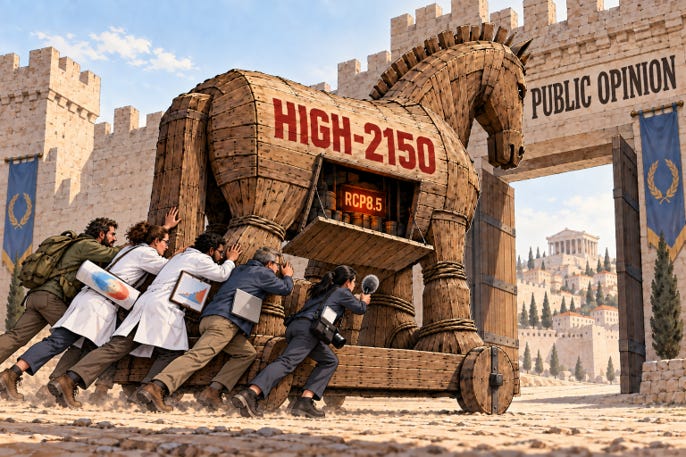
Below I show how RCP8.5 is being brought right back into the discussion of climate science and policy via a Trojan Horse that carries a misuse of scenario extensions.
Step 1: Move the goalposts
Wallace-Wells and Hausfather forecast an apocalyptic-sounding future, which they characterize with a 75% likelihood this century:
At three degrees higher [Celsius temperature increase over 1850-1900], the world’s ice sheets would be committed to millenniums of retreat. The share of species on land facing a high risk of extinction could double.
How likely is this future? According to conventional modeling of today’s policies and pathways, the odds are about even by 2100 — and three in four by 2150.
However, the claim that “conventional modeling of today’s policies and pathways” extends to 2150 is simply false.
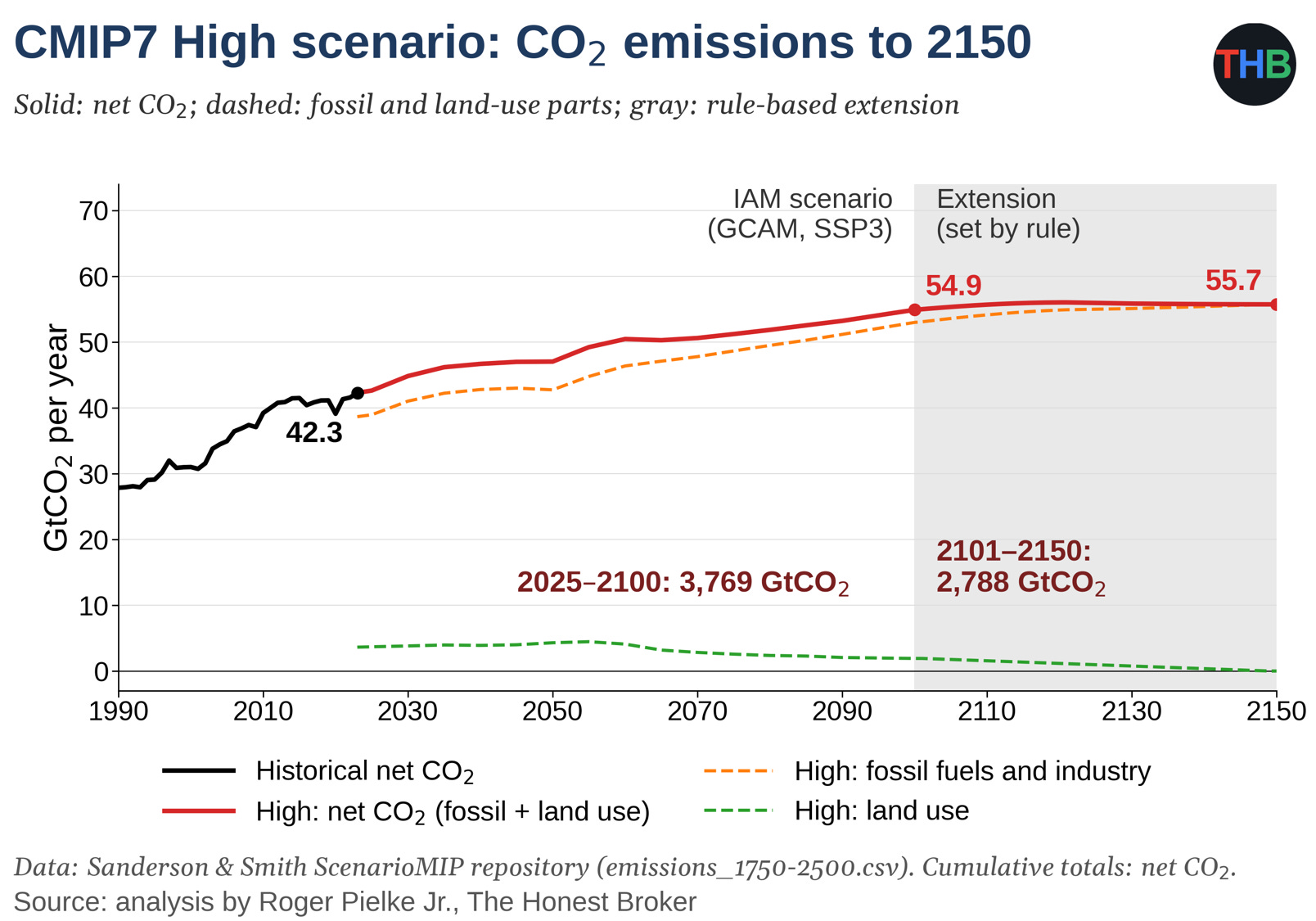
The creators of the new CMIP7 scenarios have created extensions of the scenarios out to 2500, but they are explicit (and responsible) in disclosing that these extensions are not based on modeling of policies and pathways (emphases added):
[T]he scenario extensions will consist of emission and concentration trajectories to 2500 AD that are decoupled from the outcomes of IAM [Integrated Assessment Model] simulations. While IAMs are useful in generating the plausible evolution of greenhouse gas emissions in the shorter-term, beyond the end of this century the uncertainties that increasingly affect the socio-economic drivers of these trajectories end up limiting the usefulness of IAMs for scenario design.
The scenario extensions were not created to produce plausible futures much less “forecasts” of the future but instead to “explore the long-term Earth System dynamics“. The exploratory use of the extensions is entirely appropriate from a scientific perspective.
However, such extensions are not created to represent plausible futures, and thus they provide no basis for forecasts or plausible projections of the future.
However, moving the goal posts to 2150 is necessary to revive RCP8.5.
Step 2: Use 2150 as the basis for alarming predictions
Having argued (incorrectly) that the “scientific community” has modeled policies and pathways to 2150, the op-ed next extends its forecasts to 2150, again based on Hausfather’s blog post:
There is also a voluminous scientific literature about an even more hair-raising level of temperature rise — between four and five degrees Celsius of warming this century. This is the true climate doomsday stuff, with most effects growing exponentially worse and damages compounding, likely arriving faster than farms, cities, coastlines and ecosystems can properly adapt. Recent models tell us that current policies give us about a 25 percent shot at exceeding four degrees by 2150.
The reference here is to the new CMIP7 MEDIUM scenario, which has an exploratory extension which adds emissions of about 1,300 gigatonnes of carbon dioxide from 2100 to 2150.
In a companion blog post to the op-ed Hausfather goes further:
There is also no guarantee that we will stay in a current policy world. While I hope that countries will strengthen climate action over time, as we’ve seen in the US its also possible to directly subsidize fossil fuels and put up barriers to clean energy deployment.
In a world of policy reversal and active support for fossil fuel burning (the CMIP7 “High” scenario), we could end up well above 3C by 2100, have a ~70% chance of >4C by 2150, and a 30% chance of over 5C.
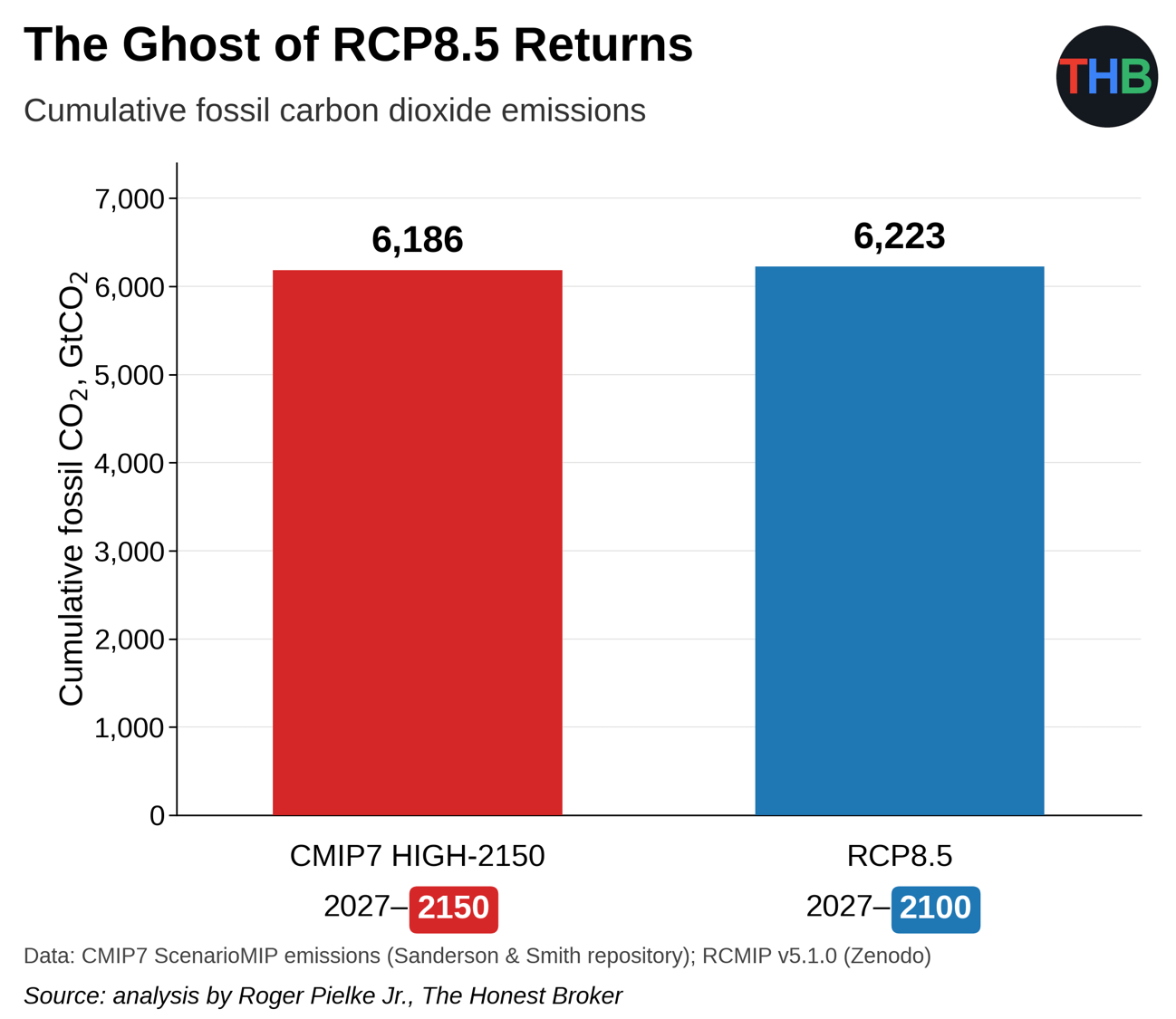
The HIGH-2150 scenario does indeed result in outcomes eerily similar to RCP8.5. The figure below shows why that is — HIGH-2150 has essentially identical cumulative carbon dioxide emissions to RCP8.5 to 2100.
The figure below shows the emissions trajectory of the HIGH-2150 scenario — the IAM modeled emissions to 2100 plus the specified extension from 2100 to 2150. Emissions increase steadily over the next 125 years, and are still rising in 2150.
The CMIP7 scenario committee noted that some assumptions may simply not be feasible, due to their “geophysical plausibility” (recall the Ritchie and Dowlatabadi 2017 critique of RCP8.5 — it hold here as well):
[S]ome outlier scenarios challenge current estimates of geophysical feasibility
But CMIP7 also reminds us that the extensions are meant to be exploratory, not necessarily plausible.
The table below shows that HIGH-2150 has radiative forcing levels just about exactly the same as the original versions of RCP8.5 and SSP5-8.5 to 2100. We have come full circle.
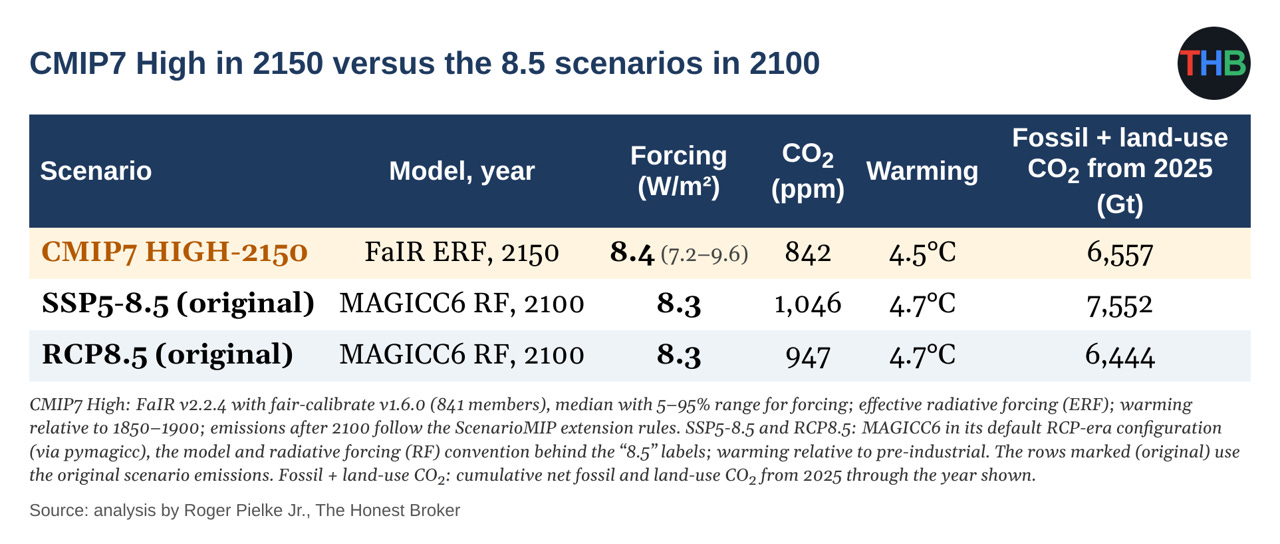
For all practical purposes, HIGH-2150 is RCP8.5.
Have a look inside that horse at the gate, it is not what we think it is.
Bottom Line
Going forward, we should recognize that the CMIP7 HIGH scenario presented out to 2150 is just a repackaged RCP8.5.
The issue here goes far beyond one NYT op-ed. Hausfather, a lead author for the IPCC AR7, informs me that:
[I]n the AR7 we are having all CMIP7 ScenarioMIP runs go through 2150.
We are not doing this all over again, are we?
If you think that replaying the RCP8.5 debacle all over again is a really bad idea please click that “❤️ Like” button!
I’m happy to publish a response here at THB
from Wallace-Wells and Hausfather
Comments, questions, critique all welcomed!
Check out the new THB Data Dashboards and Tools:
Decarbonization Around the World
US Extreme Weather and Climate Change
Global Extreme Weather and Climate Change Dashboard
THB Build Your Own Climate Scenario Tool
and the new
And there is lots more to come
Thank you!
Hausfather explains the origins of his forecasts: “To compare warming outcomes across scenario generations on a like-for-like basis, Carbon Brief ran both the seven CMIP7 scenarios and the CMIP6 SSP emission scenarios through the same simple climate model.” Anyone can of course produce a forecast — caveat lector — but representing a self-authored blog post as the views of the “climate science community” is quite something.
No negative personal comments about individuals here - Thanks!
Roger: Thanks for remaining alert to this effort to resurrect RCP8.5. I hope that you do not grow weary of such vigilance.