


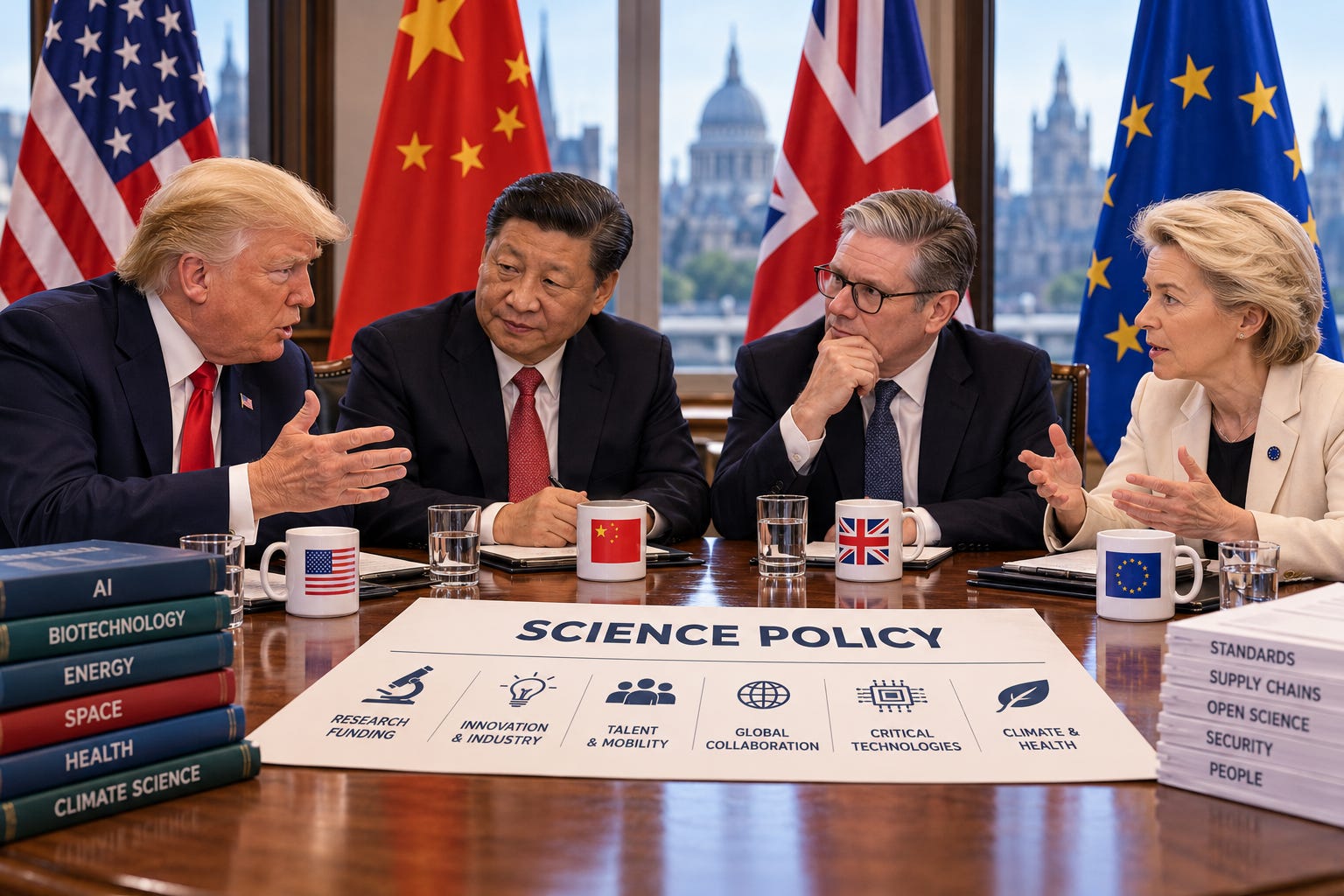
A common justification for greater US federal investment in research and development is that such funding is necessary to keep pace with China.
For instance:
Representative Raja Krishnamoorthi, the top Democrat on the House Select Committee on the Chinese Communist Party, warned in 2025 that “While Washington is distracted, Beijing is racing ahead.”
In May, 2026 the Information Technology and Innovation Foundation reported that China had overtaken the United States in R&D investment and urged more federal support.
At a Senate hearing in July, 2026 former National Science Board member Julia Phillips said that “the US must renew its investments in and commitment to its historic strengths.”
In August, 2026 Senator Adam Schiff (D-CA) wrote to President Trump that without robust federal funding “we are at grave risk of ceding influence and power to our competitors abroad.”
Last week, the National Natural Science Foundation of China (NSFC) launched the China Fundamental Research Report (2026) in Beijing. The report tracks fundamental research across 25 countries and regions from 1985 to 2024, and documents China’s remarkable rise to a global R&D superpower.
In today’s post I offer three reasons why calls for more US federal R&D funding in response to China’s rise is unlikely to be effective as a political strategy to secure more public support for R&D or as a policy strategy in response to China’s rise:
Scale. China’s government already funds R&D on a scale comparable to or larger than the US government, with budgets growing every year. China has already assumed a role in R&D comparable to that of the US.
Direction. The report’s authors attribute China’s gains to institutional continuity, while the United States has moved from mission-oriented research toward government-directed science — which in a democratic system creates instability and inefficiencies in the R&D system.
Legitimacy. Every research system — in democracies and beyond — is based on a social contract between science and the public, and in the West that contract has lost much of its force due to polarization and politicization.
Tomorrow, Tuesday 27 October, from 14:00 to 16:00 UK time, from University College London (UCL) I will join a panel that offers the first international discussion of the report — an online event hosted by UCL, the Research on Research Institute and the NSFC–Wuhan University Observatory for Global Fundamental Research (free registration, please join us if you are interested!).
This post reports my thinking as I’ve prepared for the panel. I welcome your comments and critique!
Scale: China has caught up
In 2022, the latest year in the US National Science Board’s international comparison, the US government invested 18.1% of US gross domestic expenditure on R&D (about $167 billion). China’s government invested 17.8% of its domestic expenditure.
The figure below compares the US and China under three conversions from yuan to dollars.
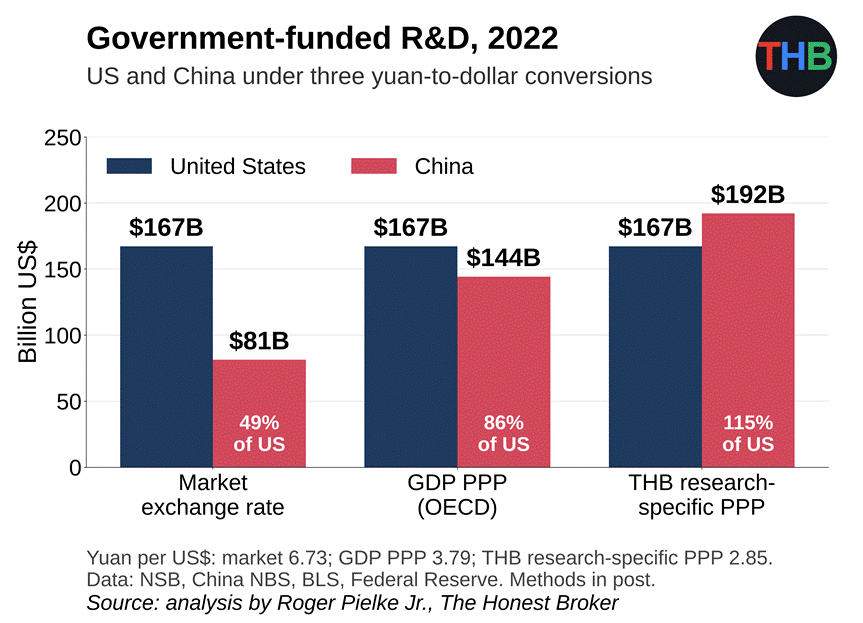
At the 2022 market exchange rate, China’s government funded $81 billion of R&D, 49% of the US level.
At the GDP purchasing power parity (PPP) rate used by the OECD and the National Science Board, China invested about $144 billion, or 86% of the US level.
Using a research-specific PPP series that I built for this post (see methods at the bottom for details), China’s R&D investment totaled $192 billion, or 115% of the US level.1
Note that this analysis in this post covers just government spending — in both the US and China the private sector funds most R&D. For total R&D, the OECD reported in March that China’s total R&D spending “caught up with and even surpassed” the US level in 2024 (in PPP dollars).
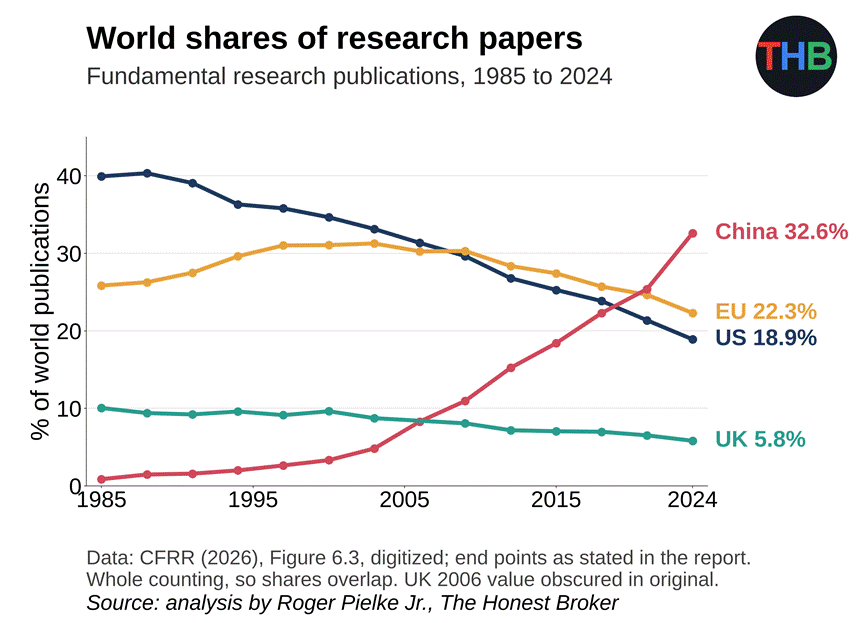
China’s increased government R&D investments have achieved notable results: China’s share of the world’s fundamental research articles rose from 0.9% in 1985 to 32.6% in 2024, passing the US in 2019, while the US share fell from 39.9% to 18.9% (Figure 2; CFRR, Chapter 6).
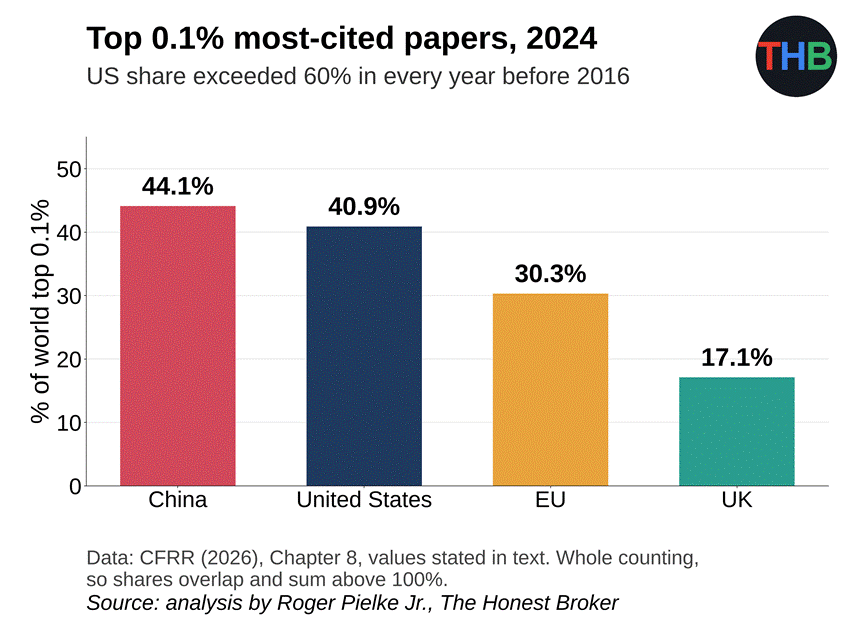
In 2024, China also produced 44.1% of the world’s top 0.1% most-cited papers, above the US share of 40.9%, which had exceeded 60% in every year before 2016 (Figure 3; CFRR, Chapter 8).
See both time series reproduced in the figures below, using data from the new report.
Fundamental research remains the area of the largest US lead. China devoted 6.9% of its R&D to “basic research” in 2024 versus 14.6% in the United States. As I have long argued, the concept of “fundamental” or “basic” research is a slippery one that requires caution in interpretation. Even so, the numbers are striking.
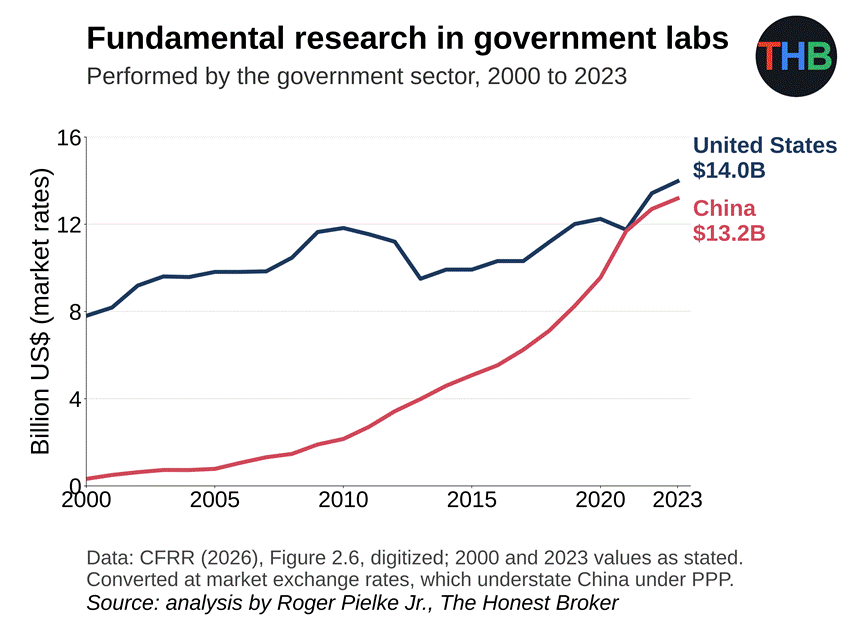
At market exchange rates, as used in the new report, China’s fundamental research spending nearly doubled from 2018 to 2023, to $31.9 billion, about 23% of the US level (CFRR, Chapter 2).
For comparison, using PPP dollars, China invests about 43% of the US level at GDP PPP and about 57% at the THB research-specific PPP rate. Within government laboratories and institutes, however, China has nearly matched the United States even at market exchange rates: $13.2 billion of fundamental research in 2023, 94.4% of the US government sector’s $14.0 billion (Figure 4; CFRR, Chapter 2).
What would more federal US money accomplish in a race against China?
Matching China’s 2022 government R&D at the THB rate would take about $25 billion a year in new government funding, a 15% increase. Congress has not funded even the levels it authorized: for instance, in FY2024, NSF received about $6.5 billion less than its congressional authorization in the CHIPS and Science Act (Federation of American Scientists). President Trump’s FY2027 budget request would cut nondefense R&D by 10% and NSF by 55% — proposals that Congress has routinely ignored in past years.
Dollars alone will not restore the US dominance of a generation ago. That era is over.
US policy makers and R&D advocates should stop asking how much more can we spend on R&D and start asking what that spending is for.
Direction: from mission-oriented to government-directed science
In 1945, Vannevar Bush articulated a social contract for American science: the public through Congress would invest in R&D and give researchers ample scientific autonomy — in return, the public should expect broad-based societal benefits from scientific and technological advances resulting from those investments.
Congress funds most federal science through agencies such as NIH, USDA, the Department of Defense, and the Department of Energy, and sets their priorities through the legislative process, sometimes at the request of the president, such as when President John Kennedy called for a Moon landing in the 1960s.
This is mission-oriented science — so named because it is conducted by agencies with specific legislated missions, typically enacted in their founding legislation.
Only three US science agencies have a legislated mandate to support basic research: NSF, NASA, and parts of DOE. But even these agencies perform research that is expected to benefit society.
An alternative to mission-oriented science is government-directed science, in which the executive sets R&D priorities through top-down decisions.
When presidents govern science by executive order and budget directive, they skip the negotiations through which Congress reconciles competing demands for public money — risking the legitimacy of the social contract.
Dan Sarewitz and I called the reconciliation of the supply of science with the demand for it the “neglected heart” of science policy. Government-directed science furthers that neglect.
Recent US science policy shows both approaches, with a turn toward government direction under the Trump administration:
Mission-oriented, through Congress. For example, in August 2022, President Biden signed the CHIPS and Science Act, which passed the Senate on a bipartisan basis — 64 to 33. The law provided $52 billion for semiconductor manufacturing and R&D and formally authorized an NSF directorate focused on up to 10 key technology areas.
Government-directed, from the White House. In August 2025, President Trump ordered each agency to have a senior political appointee review all funding announcements and discretionary grants for alignment with “agency priorities and the national interest.” In November 2025, his Genesis Mission order directed the Department of Energy to name at least 20 national science and technology challenges. In May 2026, OMB proposed a rule that would require a senior political appointee to review every discretionary award before issuance and would make peer review recommendations “advisory only.”
Supporters of government-directed R&D are correct when they argue that voters elect presidents to set national priorities. But when legislators bargain to produce legislation, they build coalitions across parties that outlast any single administration, creating continuity in R&D priorities that simply cannot exist when the presidency swings from one party to another every four or eight years.
According to the new report, China’s funding system — not grounded in democratic accountability — embodies a “combination of institutional continuity and gradual adaptation,” in which NSFC has kept “investigator-initiated applications, peer review, and competitive selection as core features” since its founding in 1986 (CFRR, Executive Summary and Chapter 11).
The US cannot emulate China’s R&D system of government-directed research and nor should it try to — instead, the US should refocus on making science policy through the messy legislative process, involving the executive branch, but not outsourcing its constitutional responsibilities.
Legitimacy: the social contract for science
In 1995 and 1998, Rad Byerly and I discussed the post-war social contract: society, through government, gave science “both money and relative autonomy” and in return reaped “the practical benefits that inevitably result.” The end of the Cold War, we asserted, “replaced an overarching justification for research with a question mark.”
Our conclusion: “The scientific community needs to negotiate a new contract with the society that funds it.”
I have argued elsewhere here at THB that a renegotiated social contract new emerged after the Cold War, leading to the situation that US science policy finds itself in today.
In the figures below, I plot GDP per capita in constant 2021 PPP dollars from 1985 to 2025, and in the lower graph I set each series to 100 in 1985. While the US has a much higher per capita GDP than does China, the increases in relative per capita GDP have been much greater in China, arguably making it much easier for the typical person to associate being better off with investments in R&D.
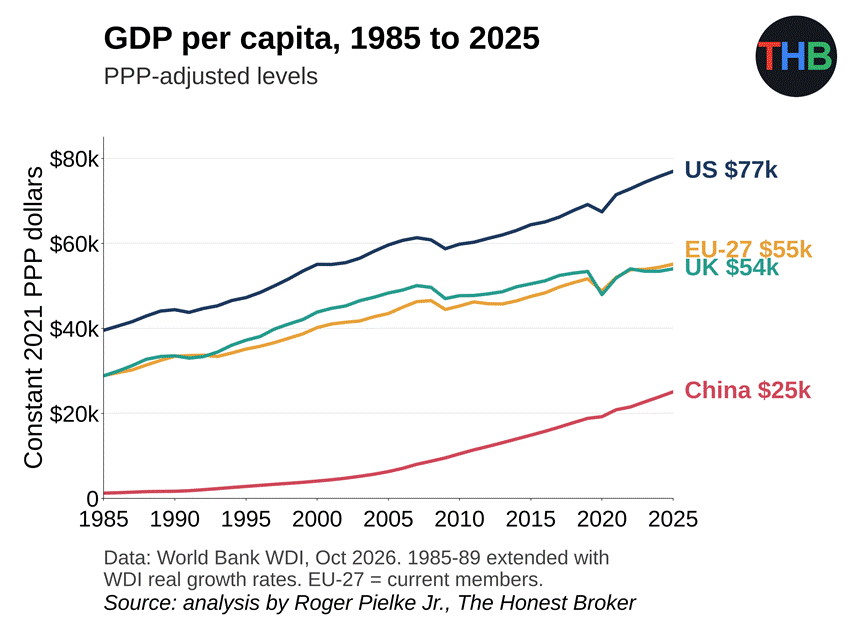
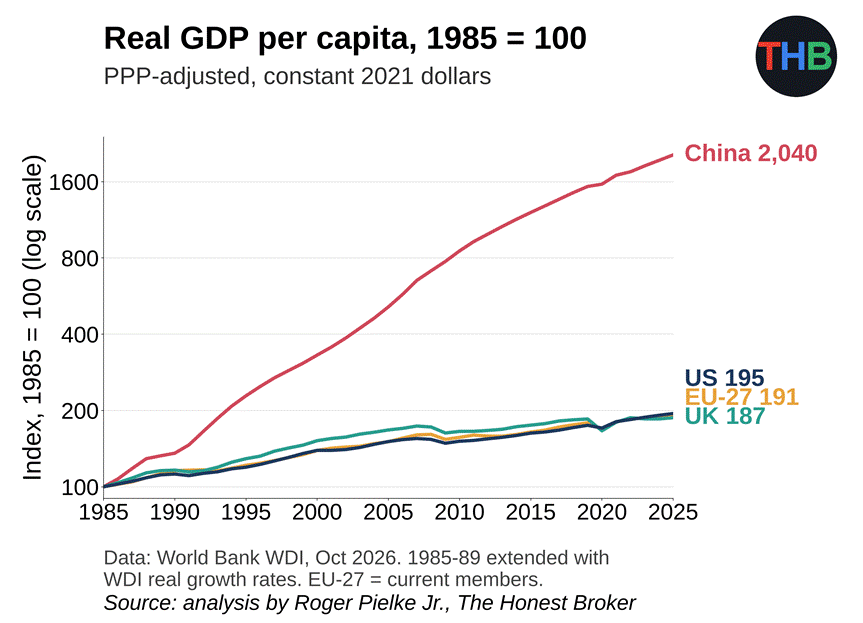
Americans, Britons, and Europeans roughly doubled output per person over the same 40 years — a significant achievement — and the US is now substantially above the EU and the UK.
But typical households saw smaller gains. US real median household income rose 39% from 1985 to 2025 (Census Bureau via FRED), less than half the 95% growth in output per person.
As has been documented here at THB, US confidence in scientists fell from 87% in April 2020 to 77% in a survey published in January 2026, with 90% of Democrats and 65% of Republicans expressing confidence (Pew Research Center).
In parallel surveys in 2020, 50% of Chinese respondents and 33% of Americans expressed “a great deal” of confidence in scientists (Qian, Jin and Xie). China’s lead here is substantial.
For seven decades, R&D advocates have justified calls for more more federal funding by pointing to rivals: the Soviet Union after Sputnik, Japan in the 1980s, and China today. During the Cold War, that line of argument won broad support, because Americans shared a sense of threat and saw their living standards rise. That is not the case today.
In comparison, at China’s 2024 national science and technology conference, Xi Jinping linked national strength to scientific progress and set the goal of building China into “a great country in science and technology by 2035.” For the typical Chinese citizen, these benefits are much more visible.
US science policy is unlikely to achieve any sort of broad national consensus based on concerns over an external threat — whether that is China or something else. Instead, such a consensus will require renegotiating the social contract at home based on tangible benefits that typical people can see and feel.
The bottom line
China’s model has significant strengths: four decades of continuity, steady growth in funding, and heavy investment in early careers.2
Democracies simply cannot replicate that model: Voters, legislators, experts, and the media contest research priorities in public, year after year.
That means that democracies are more likely to get durable and effective science policies through legislative bargaining, and much less durable and effective policies through executive (or ministerial) decree.
In this context, simple calls for more money to counter China’s rise are almost certain to fail as politics or policy.
Under a renewed social contract — negotiated in Congress and authorized and funded in law — elected representatives from both parties would together tie public research funding to benefits that typical households experience in health, jobs, prices, and living standards.
Recommendations for US policy makers
I have three recommendations for US policy makers that derive from this analysis:
1. Congress should reinvigorate the authorization process and reassert its constitutional primacy in setting and funding national research priorities. The Constitution gives Congress the power of the purse: “No Money shall be drawn from the Treasury, but in Consequence of Appropriations made by Law” (Article I, Section 9). Congress already defines agency missions in organic acts. In the National Science Foundation Act of 1950, for example, Congress charged NSF “to promote the progress of science; to advance the national health, prosperity, and welfare; to secure the national defense.”
Congress has increasingly neglected turning those missions into specific priorities in agency authorizing language. For instance, in FY2025, Congress appropriated $500 billion for programs operating under 457 expired authorizations (CBO).
Because Congress wrote agency charters broadly and let reauthorization lapse, presidents of both parties have set specific priorities by executive action, and their successors have reversed those priorities, creating churn in R&D implementation.
For instance:
In 2001, President George W. Bush limited federal funding for embryonic stem cell research to existing cell lines, and in March 2009, President Obama lifted those limits by executive order (Christian Science Monitor).
In October 2023, President Biden issued a sweeping executive order on artificial intelligence, and on 20 January 2025, President Trump revoked it (Covington).
In 2025, NIH terminated more than 1,800 grants and slowed new awards, obligating about $8 billion less from February to June than a year earlier. In August, 2025 the Government Accountability Office found that NIH had violated the Impoundment Control Act.
Congress should limit executive power to set and reverse research priorities by executive order. Specifically, Congress should:
reauthorize NSF, NIH, NASA, the DOE Office of Science, and other agencies that support R&D on regular schedules, with specific research priorities written into each reauthorization;
appropriate research funds with a projected multiyear outlook that spans presidential terms to give an expectation of policy direction and prioritization;
write the role of peer review in individual awards into statute, perhaps under long-proposed-but-never-enacted legislation on scientific integrity; and
enforce the Impoundment Control Act and add appropriations language that makes it difficult fort agencies to terminate awarded grants — to reduce the role of executive branch meddling in R&D implementation.
Legislative primacy improves science policy in three ways:
Stability. Priorities written into law change only with a new congressional coalition that changes the law, so the R&D ecosystem can plan across presidential terms.
Priorities that better reflect broad public will. Through hearings, markups and votes, members of Congress weigh the demands of patients, industries, regions and taxpayers against the capacities of science — the neglected heart of science policy.
Accountability. Through regular reauthorization, elected representatives express what the public expects from research and congressional oversight provides a check on results, turning the implicit social contract into an explicit and renewable bargain with the outcomes of that contract clearly on display for all.
Legislative primacy also gives the United States its best chance to compete with China.
2. The White House and OMB should withdraw the proposed grants rule and fund awarded grants through completion. Presidents can propose national goals and win congressional support for them, as Kennedy did with the Moon landing. But the founders created Article 1 on the Constitution for a reason.
OMB should withdraw its proposed rule on government-directed science, and agencies should honor awarded grants through completion, barring misconduct or failure to perform.
Of course — under the Trump administration, this won’t happen.
The next president and the Congress that he or she works with should collaborate to restore federal governance in line with the expectations of the US Constitution.
The risk of course is that government-directed research becomes accepted by both Democrats and Republicans — with R&D policy making continuing to see-saw dramatically from one administration to the next, throwing sand into the gear of the US science and technology enterprise.
If this happens, it won’t be just China that leapfrogs the US.
3. Scientists and research universities should ground their case for funding in benefits visible to typical households, alongside whatever warnings they make about the rise of China. Leaders of research universities, scientific societies and the National Academies should report what public research delivers to American citizens in health, jobs, prices, and living standards — in terms that a typical household can check against its actual experience.
Scientific leaders should take the social contract seriously, which also means working to depoliticize the overtly partisan slant taken on by many important institutions of science. Notably they should correct course from the partisan turn taken by many universities, professional societies, and the National Academies.
Science and the benefits of R&D are for everyone, regardless who they happen to vote for.
The best US answer to the rise of China as a global R&D power starts at home, with a renewal of the social contract between science and the public.
Before you go, please click of the “❤️ Like” button!
Comments and discussion welcome
THB is made possible by its subscribers. Please consider a free or paid subscription — Thanks!
Check the new THB Data Dashboards and Tools:
Decarbonization Around the World
US Extreme Weather and Climate Change
Global Extreme Weather and Climate Change Dashboard
THB Build Your Own Climate Scenario Tool
THB US Deficit and Debt Explorer
and the new
Please share — Thank you!
Further Reading
Bush, V. (1945). Science, the Endless Frontier. US Government Printing Office.
Byerly, R., Jr. and R. A. Pielke Jr. (1995). The changing ecology of United States science. Science 269(5230): 1531–1532.
Dougherty, S. M., R. Inklaar, R. H. McGuckin and B. van Ark (2007). International comparisons of R&D expenditure: does an R&D PPP make a difference? NBER Working Paper 12829.
Information Technology and Innovation Foundation (2026). China overtakes the United States in R&D investment. 6 May 2026.
National Science Board (2025). Science and Engineering Indicators 2025: Discovery, Table DISC-11. National Science Foundation.
Nolan, B., M. Roser and S. Thewissen (2016). Stagnating median incomes despite economic growth: explaining the divergence in 27 OECD countries. VoxEU, 27 August 2016.
NSFC–Wuhan University Observatory for Global Fundamental Research (2026). China Fundamental Research Report (2026). Lin Zhang, project director.
OECD (2026). OECD overall R&D growth stable; government R&D budgets decline and reorient towards defence. Statistical release, 31 March 2026.
Pew Research Center (2026). Americans’ confidence in scientists. 15 January 2026.
Pielke, R. A., Jr. and R. Byerly (1998). Beyond basic and applied. Physics Today 51(2): 42.
Qian, Y., Y. Jin and Y. Xie (2021). Belief in science and attitudes toward COVID-19: a demographic standardization approach to China–US comparison, 2020. China CDC Weekly 3(30): 645–649.
Sarewitz, D. and R. A. Pielke Jr. (2007). The neglected heart of science policy: reconciling supply of and demand for science. Environmental Science & Policy 10(1): 5–16.
Schiff, A. (2026). Letter to President Trump on science and research funding. 4 August 2026.
Wilsdon, J. (2026). The frontier is fundamental. Research on Research Institute, 20 October 2026.
World Bank (2026). World Development Indicators: GDP per capita, PPP (constant 2021 international $). Updated 8 October 2026.
Zhang, L. (2026). How to compare and strengthen research systems. Nature 658: 843.
Methods
Government-funded R&D. I took 2022 gross domestic expenditure on R&D (GERD) and the government-funded share from the National Science Board: $923.24 billion and 18.11% for the United States, 17.77% for China. I took China’s GERD of 3,078.29 billion yuan from the NBS. The GDP PPP rate of 3.79 equals China’s GERD in yuan divided by its GERD in PPP dollars in the NSB table. I took the 2023 market exchange rate of 7.08 from the Federal Reserve. The $25 billion gap equals $192 billion minus $167 billion.
Fundamental research. The report’s authors convert China’s fundamental research spending at market exchange rates; China’s 2023 total of 225.9 billion yuan (NBS) equals $31.9 billion at the 2023 rate of 7.08 yuan per dollar. To compare at PPP, I scaled the report’s 23% ratio by the ratio of the market exchange rate to each PPP rate. Because I applied 2022 PPP rates to 2023 spending, I treat the results as approximate.
The THB research-specific PPP series. I built this series for this post to estimate the yuan needed to buy the research inputs that one dollar buys in the United States. For 2022, I combined three rates:
Research labor, weighted 49%: average pay in China’s scientific research and technical services sector, 163,486 yuan (NBS), divided by mean pay in US scientific R&D services, $123,330 (BLS), for 1.33.
Other current costs, weighted 42%: the OECD GDP PPP rate of 3.79.
Equipment and capital, weighted 9%: the market exchange rate of 6.73, since research institutions buy much of their equipment on world markets.
The weighted rates sum to 2.85 yuan per dollar. I took the labor and capital weights from the cost shares of research inputs in Dougherty, Inklaar, McGuckin and van Ark and assigned the remainder to other current costs. For both countries, I used average pay across all employees in the sector, and I treat Chinese and American research workers as equal inputs. Doubling the labor rate to 2.65 raises the series to 3.50 and puts China at 94% of the US level.
GDP per capita. I used World Bank GDP per capita in constant 2021 PPP dollars (updated 8 October 2026), which begins in 1990. The World Bank converts each country’s output at one fixed rate for every year, so growth in constant PPP dollars matches growth in constant prices. I therefore extended each series back to 1985 with World Bank real per capita growth rates from its constant-dollar series. For the EU-27, I used the World Bank aggregate for current members.
Notably, the Chinese R&D workforce is much cheaper than its US equivalents. Even if we double the cost of Chinese research labor in this exercise, China R&D investment is 94% of the US level.
NSFC’s Young Scientists Fund accounted for more than 40% of its awards in 2024. Among Chinese researchers who began their careers in 2019, nearly 80% had an early publication acknowledging NSFC support, up from about 50% of the 2000 cohort (CFRR, Executive Summary).
I appreciate the calls for science reform, and certainly we need new and updated approaches to this. BUT the loss of trust among the public is real and severe. The truth is that we don’t want to fund more of it because we no longer believe in it. It’s not that we don’t believe science; we don’t believe in the practitioners to actually perform science. The process has been corrupted by politics and money and bias to the point where most of what’s called science is just advocacy. We’ve had enough.
There’s no way to reform the scientific process without restoring public trust, and there’s no way to restore trust without a collective mea culpa from the scientific community. We the public know we’ve been misled, and until there are admissions and true accountability we want no more of it. Climate science itself is now almost laughably inept: why on earth would we spend one more penny on it?
Twenty years ago Orange County California went bankrupt, and the task force studying it came up with their brilliant solution: more taxes. We voted it down in record quickness, because there was no way we were giving more money to the people who messed it up in the first place. The same is true of today’s science environment: why would we give more money to a system we’ve proven has failed us? Answer that and we may have a chance.
Impressive review of Institutional Science, Roger. Remember the old adage: "Anything worth doing is worth doing well"? Well, that is not true of innovation. When something new is conceived, it doesn't need to be done well. Anything worth doing, really worth doing, is worth being done poorly.
The first wheel was not very good.
The first computer wasn't very good.
You know that early products or ideas are sloppy and full of error... but they came together and were made better by doing them well. But the first ones, the innovation, isn't done well.
So Asia doesn't innovate. It steals and then perfects with the idea of the assertion that "anything worth doing is worth doing well". That attitude perfects, it doesn't innovate.
Institutional innovation is an oxymoron. Innovation isn't generated by government funding or wrote adherence to academic training. Innovation comes from the impertinent question, the odd person in the basement or garage... Bill Gates and Steve Jobs to name a coupla recent examples. Asia doesn't develop Claude Shannon. It doesn't invent a plastics industry. It comes along and steals the idea and makes the product cheaper.
So, all the money and all the education does little to innovate or produce poorly made products that are truly new. Institutions are designed to produce automatons who perform well, but not new. Have you ever heard young Korean musicians? They are fantastic. Piano, violin, etc are played with skill and fake emotion. That is what we get from Asia... Korea, China, Japan. Lots of money poured into fake innovation, done with great skill.
All those papers from China are drivel. New ideas come from places and people who are not trained in the process of feeding the institutional beast in D.C. Freedom yields creative new ideas. Money does not. Papers reviewed by all those institutional scientists does not. You can't buy innovation, Roger. Any more than communism can produce freedom. True innovation will not end, but it will not be controlled, or predicted either.