


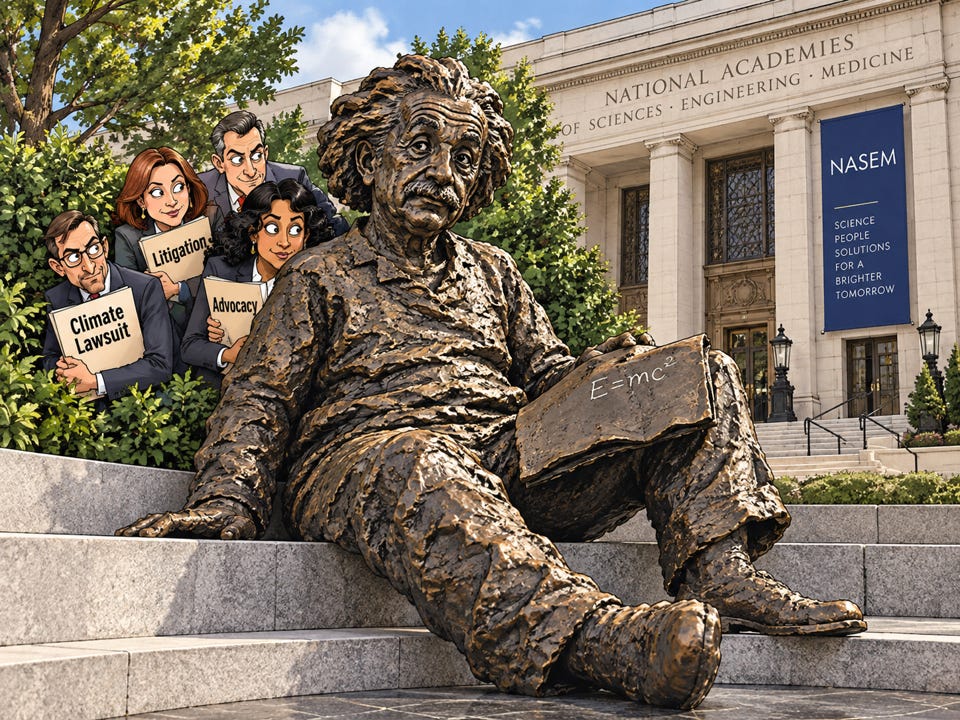
Here at THB, I often assemble complex and disparate pieces of information to tell a story that I believe is grounded in evidence and facts. It is rare that such complexity is verified in the short-term with a proverbial smoking gun of proof — today however is one of those instances.
Last week, the House Judiciary Committee released an interim staff report on its investigation into the Environmental Law Institute’s (ELI) Climate Judiciary Project (CJP) and the climate chapter of the Reference Manual on Scientific Evidence, which the Federal Judicial Center (FJC) and the National Academies of Sciences, Engineering, and Medicine (NASEM) published on December 31, 2025.
In March here at THB, I documented the ghost authorship of that chapter by a plaintiffs’ lawyer in climate litigation, Michael Burger. The NASEM/FJC chapter copied more than 40% of its text in its sections on extreme event attribution from a 2020 law review article led by Burger, in verbatim and lightly reworded passages.
Burger directs Columbia’s Sabin Center for Climate Change Law and serves as Of Counsel at Sher Edling, the law firm representing most of the cities and counties suing fossil fuel companies. The chapter’s two named authors — Jessica Wentz and Radley Horton — are his Sabin Center colleagues and coauthors on the 2020 law review article.
The contested climate chapter acknowledges in a footnote that it drew upon the law review paper led by Burger — so identifying and quantifying the ghost authorship was not exactly rocket science.
In their report released last week, House Judiciary Committee investigators revealed emails among the Sabin Center collaborators and the NASEM and FJC. The emails provide some truly remarkable details about the drafting of the chapter — details that are far worse than what I reported last March.
Specifically, the emails reveal that after NASEM invited Burger to author the chapter, the FJC removed Burger from the chapter over concern about a real or perceived conflict of interest with his litigation work.
The timeline indicates that NASEM approached Burger to be the original author of the chapter and suggested that he base it on his earlier law review paper.
Despite Burger’s agreement to the FJC request that he not co-author the chapter, he kept taking part in the drafting and editing — in his words, contributing “behind the scenes” (Exhibit 24).
The NASEM scandal is just the tip of the iceberg of a large, organized effort to repurpose institutions of expertise that are supposed to be independent and impartial to instead serve stealth advocacy in support of climate litigation.
Last week, the editorial board of the Wall Street Journal commented:
None dare call it conspiracy, but it sure looks like an organized, stealthy effort to influence how judges rule on cases.
Seven New Important Revelations From the Emails
The House Judiciary Committee report provides seven important new revelations about the chapter’s authorship.
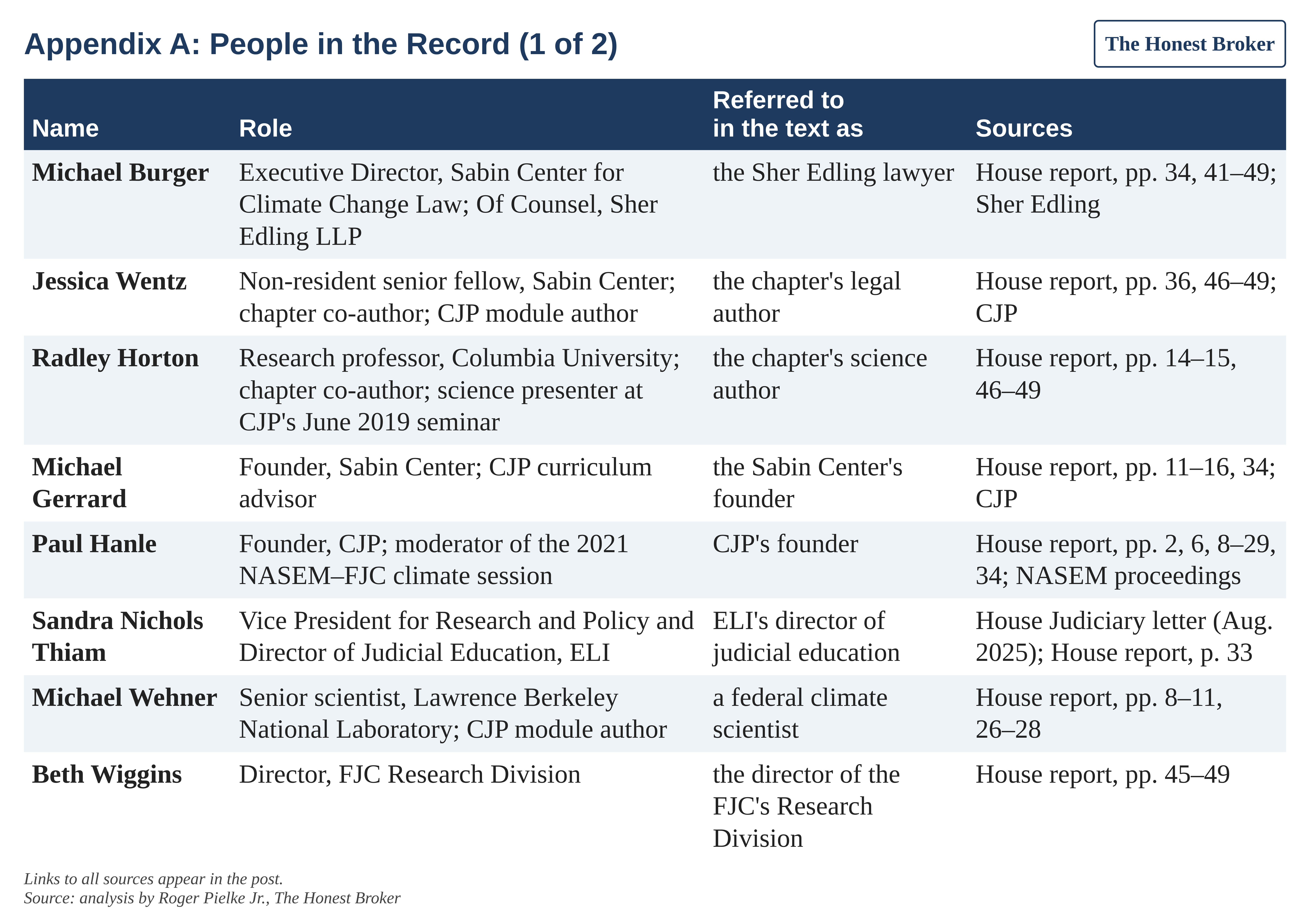
See the appendices at the bottom of this post for a detailed list of relevant participants and a timeline of events.
NASEM invited Michael Burger to author the chapter and asked him to base it on his law review article. On December 29, 2022 a senior advisor to the NASEM wrote to Burger: “We believe that much of the information for the proposed chapter is included in your 2020 co-authored law review article, The Law and Science of Climate Change Attribution.” The full invitation is reproduced below (Exhibit 22).
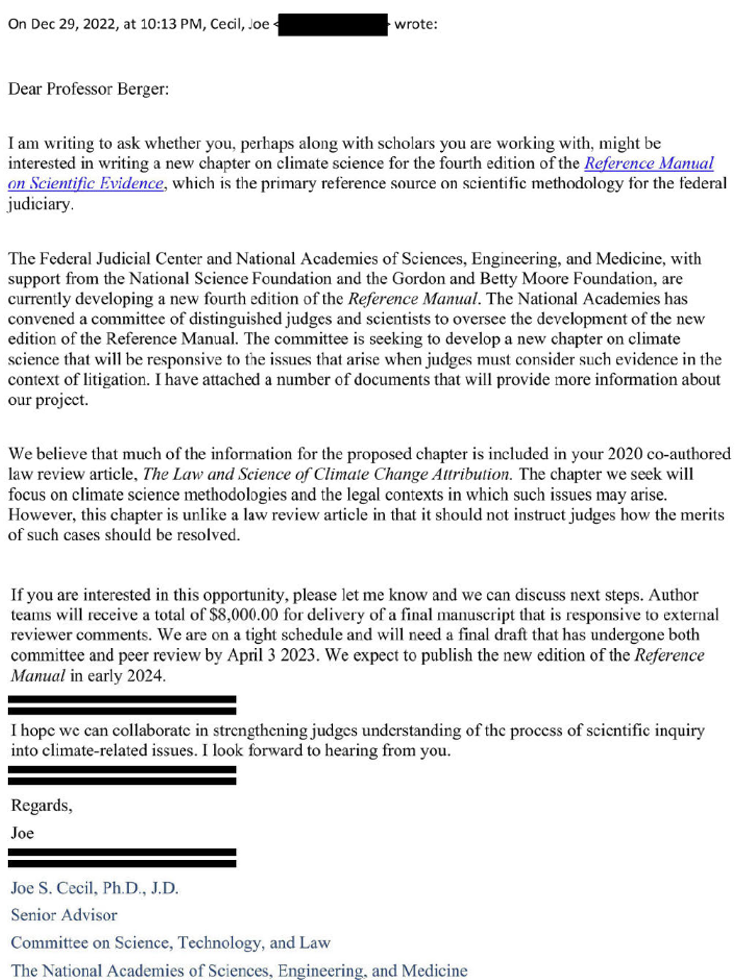
NASEM approached a plaintiffs’ attorney in climate litigation and informed him that his perspective on litigation expressed in a previously published article was what they wanted in the chapter. The process via which NASEM selected Burger is not disclosed in the exhibits released by the House Judiciary Committee.
Burger agreed to author the chapter and recommended his “co-authors” on the law review chapter — Wentz and Horton — to NASEM to co-author the NASEM/FJC chapter with him. Burger wanted his law review co-authors to join him on the chapter, which he told NASEM would “enhance the quality and authority of the chapter.” (Exhibit 22).
The FJC responded to Burger’s disclosure of his role in litigation. On March 6, 2023, the director of the FJC’s Research Division, Beth Wiggins, told the the chapter’s authors — Burger, Wentz, and Horton — on behalf of “the committee of judges and scientists overseeing the manual revision” that Burger could not author the chapter because of “his involvement in climate-related litigation” (Exhibit 23). The email further stated:
“During its last meeting, the committee … discussed the outline and the potential conflict Mike raised due to his representation of several state and local governments in lawsuits against fossil fuel companies. . . The committee highly appreciated Mike’s candor about his involvement in climate-related litigation and his recognition that his involvement might affect perceptions of the chapter’s objectivity. … the committee decided that it would be inadvisable for Mike to author it.”
In the same email the FJC requested that Wentz and Horton continue to co-author the chapter. It is not clear whether the FJC was aware that NASEM had requested explicitly that the chapter be based on the Burger et al. law review paper or that Wentz and Horton had many of the same perceived or real conflicts of interest.
The FJC conveyed to Wentz and Horton concerns of the NASEM committee of judges and scientists about bias (Exhibit 23):
The FJC conveyed concerns from the NASEM committee overseeing the production of the 4th edition scientific manual, warning Wentz and Horton about overstating the fidelity of extreme event event attribution:
“The committee had significant discussion about the difficulty of scientifically attributing climate change and its impacts to specific sources and wanted to be sure the chapter reflected this difficulty. . .
The FJC also cautioned the authors about opining on how courts should consider extreme event attribution:
Attribution issues are ones likely to be debated in court. [J]udges read the manual for the science not the law . . . It is also the place where bias toward various legal positions might inadvertently surface.”
Burger stayed on as a ghost author after being asked to recuse himself. On March 7, 2023, the day after the FJC asked Burger to step aside, he assured Wentz and Horton that he would keep “contribut[ing] behind the scenes.”
On April 26, 2023 Wentz sent Horton a revised draft with Burger’s edits to the manuscript (Exhibit 26 has the full text of the draft with Burger’s edits and comments — shaded in blue — and Wentz’s responses). Three days later she told both that she had “made a number of changes to the legal section” in response to both of their comments.
On March 20, 2026 — two weeks after my THB post revealing the ghost authorship — the Wall Street Journal published a letter from Jessica Wentz responding to the WSJ reference to my post (emphasis added):
The editorial cites an assertion by American Enterprise Institute senior fellow Roger Pielke Jr. that parts of the chapter were ghost written by our colleague Michael Burger. None of the text was written by Mr. Burger. As disclosed in the chapter, we did excerpt and adapt some content from a 2020 law review article that we co-authored with Mr. Burger. All of that content came from scientific sections that were written by Mr. Horton and myself.
The emails totally contradict Wentz’s claims.
The FJC had notice that the chapter was based on earlier work that Burger had led and co-authored. On November 3, 2023, Wentz told the FJC’s research director that she and Horton “drew heavily on our past work with him [Burger]” (Exhibit 36). According to committee staff, she “did not disclose” that Burger “had provided feedback on the [NASEM/FJC chapter] draft.” In April 2024, Wentz and Horton discussed cutting the acknowledgments to “alleviate concerns” about Burger’s role in the Chapter, and Wentz wrote that she would “confirm with him [Burger] of course.” In the end, Burger remained in the acknowledgments.
At Wentz’s suggestion, their chapter draft was reviewed by their Sabin Center colleague Michael Gerrard. FJC’s Wiggins approved the selection and hinted at the conflict of interest and expressed concern about the ELI (Exhibit 28)1:
“[I]f we could find that person, for “diversity”, it would be good to have someone of Mike [Gerrard]’s caliber with a similar background that is not associated with the Sabin Center. … I haven’t been able to identify anyone. For various reasons (not to do with their expertise), we’d prefer not to use the attorneys from ELI [Environmental Law Institute, which oversees the CJP].”
In his review Gerrard noted: “Many of the cites are to fairly old cases,
leaving the impression that some of this was mostly taken from an older document.” That was true as a significant part of the chapter was taken from the 2020 Burger et al. law review.
As I documented last March, the reuse of substantial material from the Burger et al. law review article in the NASEM/FJC climate chapter provided sufficient grounds — under well-established guidelines for scientific integrity in publishing — for Burger to be considered a ghost author.
The newly released emails add a smoking gun to that conclusion.2
The National Academies Knows Better
NASEM’s fourth-edition committee had responsibility for choosing topics, commissioning authors, approving chapters, and sending the manual to external review. The House Judiciary Committee report provides very few details on how the committee did or did not fulfill these responsibilities.
NASEM leaders were well aware of issues of scientific integrity in authorship. In 2017, NASEM’s then-president Marcia McNutt joined other science leaders at a retreat to put forward standards of integrity in scientific publishing.
They explained in a 2018 PNAS article (emphasis added):
[A] group of the nation’s leading scientists, scholars, and editors of science journals explored ways to ensure the integrity of science authorship. . . Among the authors and attendees at the NAS-Sunnylands-APPC retreat were Marcia K. McNutt, president of the National Academy of Sciences . . . The promulgated standards were designed to prevent authors from “gaming the system,” and to discourage a raft of detrimental practices such as ghost, gift, honorary, and forged authorship that can harm scientific integrity.
After the FJC withdrew the chapter on February 6, 2026 NASEM’s then-president McNutt defended the chapter in the Wall Street Journal and then told state attorneys general on February 26 that the chapter would remain on NASEM’s website.
After McNutt retired from the NASEM on June 30, 2026, on August 7, 2026 NASEM removed the chapter pending an independent review of “the processes used to develop the chapter.” NASEM has yet to publish its findings.
At the start of September 2026, NASEM’s new president, Neil Shubin, said that the chapter “followed a very different process from the reports we do,” and he stood by NASEM’s July report, Attribution of Extreme Weather and Climate Events and Their Impacts.
However, a National Review analysis compared the front matter of the NASEM/FJC chapter and that of the NASEM attribution report and demonstrated that NASEM put forward the same review standards for each — almost word for word.
NASEM’s attribution committee also heard from Burger. In a November 2024 public forum, he briefed the committee on climate litigation against oil companies and described himself as “actively involved” in Sher Edling’s cases. A committee member then asked him how the committee could “do better” at designing studies to “better inform litigation.”
It is a small world indeed.
Empanelment as Stealth Advocacy
The selection of experts to provide scientific advice opens the door to selecting experts that will deliver results favored by those doing the selecting.
Officials usually choose their experts out of public view. Sometimes they make those choices in public — revealing an intent to create expert advice that is politically convenient. For instance:
In November 2020, the Trump administration removed Michael Kuperberg as executive director of the U.S. Global Change Research Program, days after naming Betsy Weatherhead to lead the National Climate Assessment.;
After the 2020 election, the Biden White House removed Weatherhead from the assessment, replacing her with their favored lead;
Similarly, Biden’s EPA dismissed the Science Advisory Board that Trump appointees had filled;
In June 2025, Health Secretary Robert F. Kennedy Jr. removed all 17 members of the CDC’s vaccine advisory committee and replaced them with new appointees;
In August 2025, President Trump fired Erika McEntarfer, commissioner of the Bureau of Labor Statistics, the same day her agency reported weak job growth and large downward revisions.
The practice also crosses borders. For example:
In 2009, UK Home Secretary Alan Johnson sacked David Nutt as chair of the Advisory Council on the Misuse of Drugs after Nutt criticized government drug policy.
In 2022, Turkish President Recep Tayyip Erdoğan fired Sait Erdal Dinçer, head of Turkey’s statistics agency, weeks after Dinçer reported inflation at a 19-year high.
In Greece, over 15 years prosecutors pursued Andreas Georgiou, the national statistician who corrected errors in the country’s deficit figures in 2010. Greece’s Supreme Court annulled his last conviction only in August 2026.
I wrote about the Greek case in the Wall Street Journal in 2013 and warned that effectively securing expert advice to inform decision making required leadership from politicians and from experts:
Improving the ability of experts to provide input to decision making will require leadership. Politicians must unambiguously and publicly clarify what questions they wish to have the experts address, and the experts must commit to limiting their role to answering those questions—including all of the associated ambiguities and uncertainties—and refrain from using their platform to place a thumb on the political scales.
Strengthening advisory institutions offers the promise of improving the quality and use of expert advice. Rather than sending experts to jail, politicians should be making it easier for their advice to clearly be heard.
In my book The Honest Broker, I described stealth issue advocacy: when experts advance a policy agenda while presenting their work as neutral science. Institutions can practice stealth advocacy quietly through the empanelment process.
The larger scandal of efforts to influence the federal judiciary via curated expertise offers a textbook case in stealth issue advocacy.
NASEM’s choices behind the scenes shaped every stage of the climate chapter:
Scoping. The organizers of the 2021 NASEM–FJC workshop on the fouth edition manual chose CJP’s founder (Hanle) to moderate the climate session that scoped the chapter, where he described attribution as central to climate litigation.
Approval. NASEM placed on its fourth-edition committee a federal appellate judge, David Tatel, who:
co-chairs NASEM’s Committee on Science, Technology, and Law,
sat on the NASEM-FJC workshop’s planning committee,
and is listed on CJP’s Curriculum Advisory Committee (Exhibit 15).
At the workshop, he asked how to write a manual “credible to judges who are themselves perhaps climate skeptics.”
Authorship. NASEM commissioned plaintiffs’ attorney Michael Burger along with his two Sabin Center colleagues to write the chapter and requested that it be based on the Burger et al. law review article.
Review. The chapter’s co-author, Jessica Wentz, proposed CJP-linked people to the FJC as reviewers of the chapter. Wentz Also proposed her colleague as a reviewer —the Sabin Center’s founder, Michael Gerrard. The FJC declined ELI’s lawyers but accepted Gerrard.
The attribution report. NASEM’s attribution committee was stacked with people closely tied to the climate litigation ecosystem — and one resigned from the committee less than two months after I published an initial expose of the conflicts. The Committee’s first meeting had four presentations — one was by the scientist who wrote the module on attribution for the CJP curriculum for judges and the other was by Michael Burger of the Sabin Center.
Stealth advocacy is enticing because NASEM can defend each individual choice in the list above as simply routine procedure. Taken as a whole, it is difficult to come to any other conclusion than NASEM — across several of its projects — has sought systematically to manufacture a particular expert “consensus” in support of climate litigation.
I’ll close, once again, with some wise words from Jessica Weinkle:
The Reference Manual controversy suggests NASEM is as good as captured by its philanthropic funders and their political agenda. If one wanted to move the needle on this sad situation and rebuild public trust in science to improve societal stability, then holding the FJC and NASEM to account is an ideal place to dig in. The end game should be to identify and scrutinize undesirable conduct and processes that clash with public expectations of an ethical research enterprise. Both entities are created by Congressional statute, so it is well within legislators’ purview to demand and deliver a public account of what is happening in science’s dark corners.
A quick favor before you go — to share this story far and wide, please click that “❤️ Like” button!
Comments welcomed!
Check out the new THB For Paid Subscribers portal
Appendix — People and a Timeline
The tables below may be useful as companions when reading the new House Judiciary Committee report.
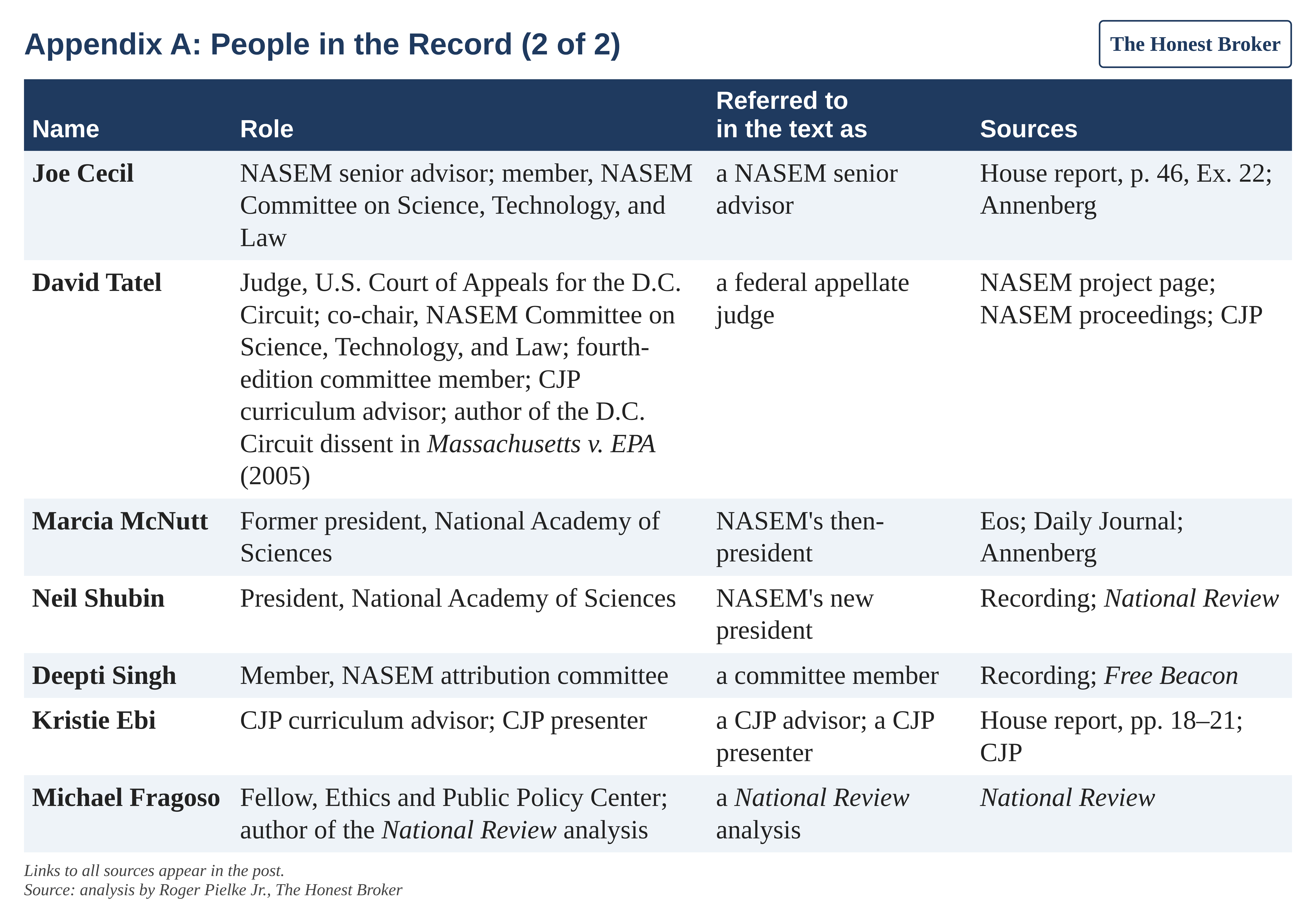
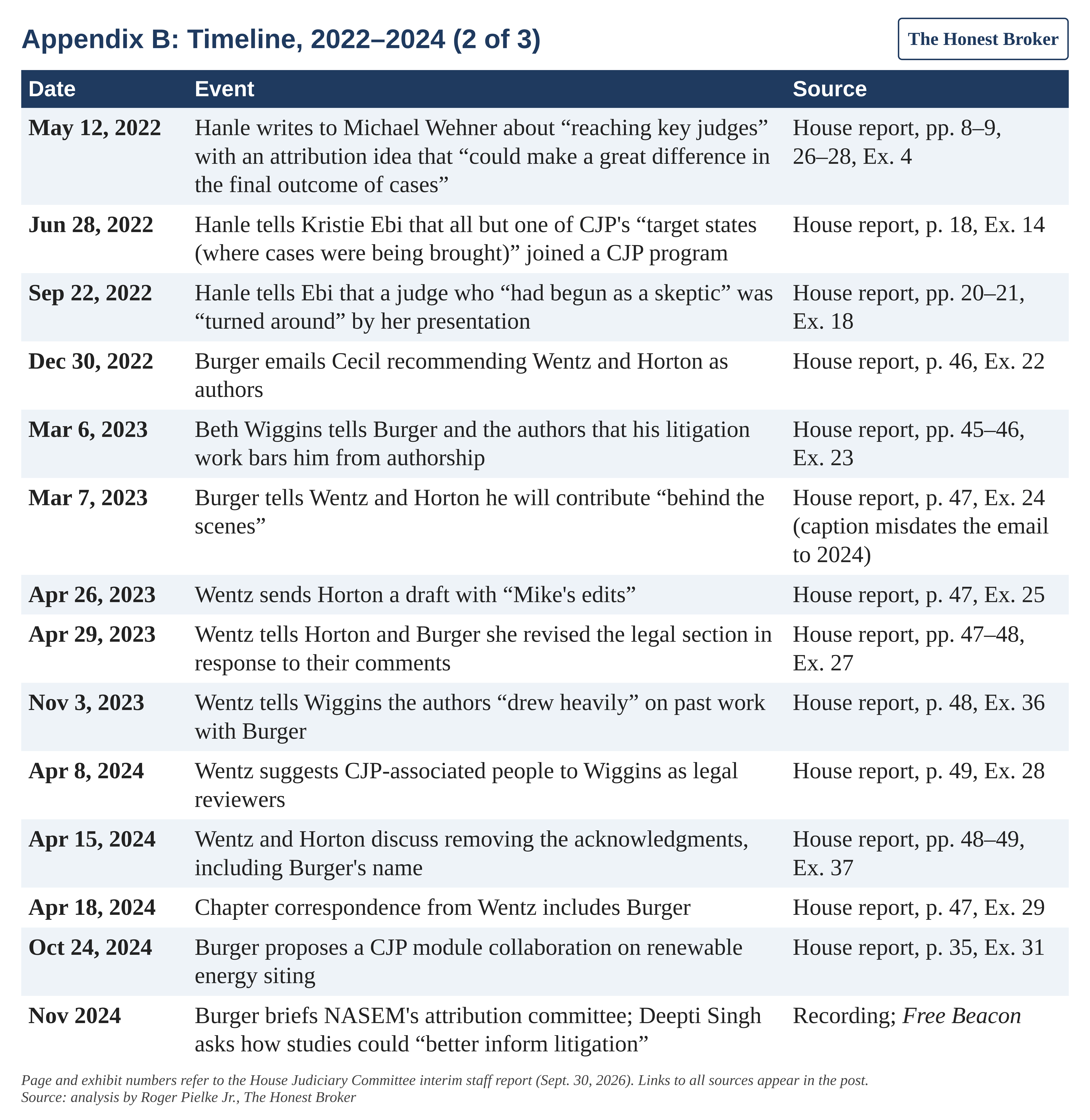
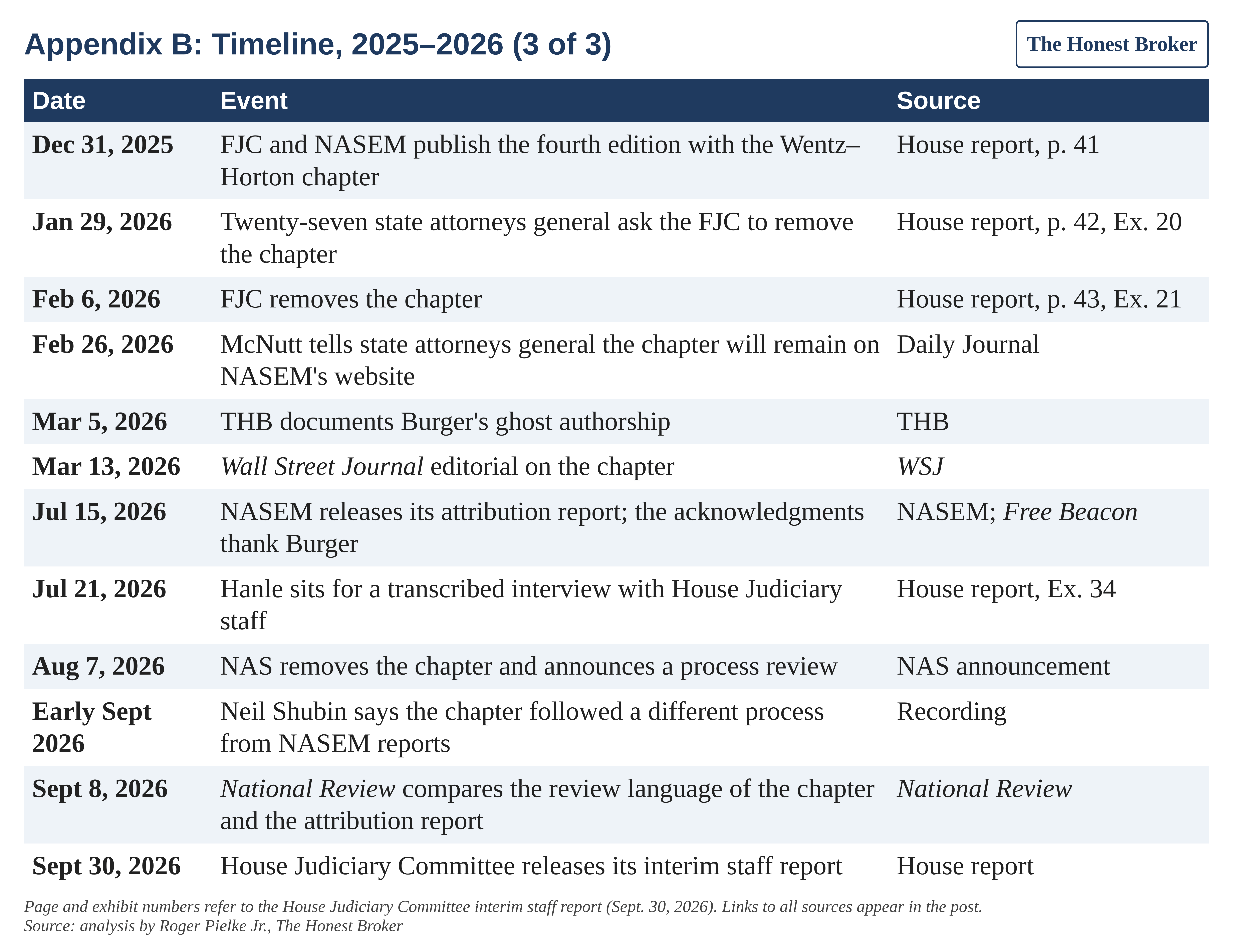
A discussion of the ELI and CJP goes beyond the scope of today’s post, but the evidence strongly suggests that they have been tightly interconnected with Columbia’s Sabin Center and the NASEM as part of the ecosystem of stealth advocacy seeking to co-opt science and influence judges..
An important side note: The chapters alteration of a quote from the IPCC to falsely suggest that the AR6 had endorsed extreme event attribution when it did no such thing was present in the 2023 draft in the exhibits, meaning that the alteration of the meaning of the quote survived at least two years of review until being included in the published version.
Thank you for the detail and clarity in your post. For very similar reasons I dropped Science as my primary source for keeping up with current research and began using alternative sources such as Research Gate and others.
Roger, having given up on worship at the Temple of Science (NASEM), I have another concern. Who gets to inform judges about whatever? Can I and my associates develop training for judges on.. say.. the science of fuel treatments in forests? What entity decides what judges need training on and who provides it? It's a bit upstream from the NASEM concerns, but still of interest.